 English
 Arabic



A Set of Complexity Measures Designed for Applying Meta-Learning to Instance Selection
Our Price
Rs3,500.00
10000 in stock
Support
Ready to Ship
Description
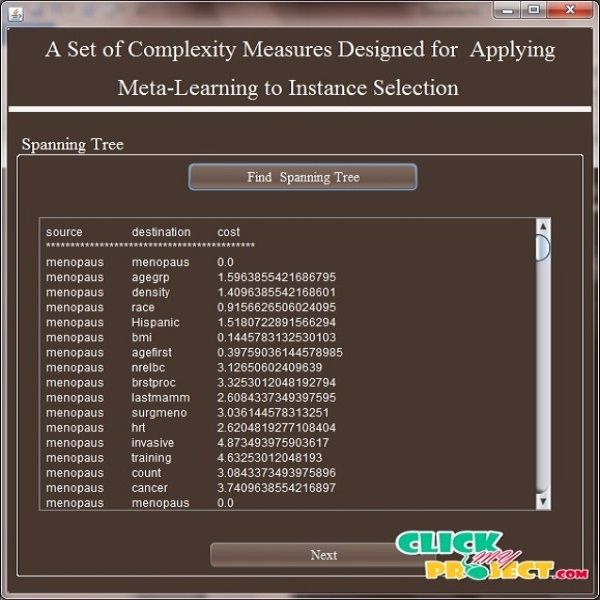
Instance selection is a pre-processing technique for machine learning and data mining. The main problem is that previous approaches still suffer from the difficulty to produce effective samples for training classifiers. In this paper, The system revises the definition of some measures, that were designed for meta-learning based instance selection. Also, The system Compare them in an experimental study involving three sets of measures, 59 databases, 16 instance selection methods, two classifiers, and eight regression learners used as meta-learners. The results suggest that our measures are more efficient and effective than those traditionally used by researchers that have addressed the instance selection from a perspective based on meta-learning. this paper provides more relevant information to learners than those used as a benchmark. The system divided c-measures into three categories, based on the information they provide: Overlap of attribute values, Separability of classes, Geometry, topology and density of manifolds. the methodology used in this paper to build the meta-data and to evaluate performance establishes novel guidelines for addressing meta-learning in IS. The system proposes an approach that differs from the classical, where a meta-classifier is trained to select the best candidate method. In this case, we used regression meta-learners trained to predict the performance of each candidate method. In multi-objective problems, as is the case of IS, such approach provides more flexibility for dealing with different weight assignments to the objectives.
Tags: 2015, Data mining, Java
Only logged in customers who have purchased this product may leave a review.






Reviews
There are no reviews yet.