English
 Arabic


Trinity On Using Trinary Trees for Unsupervised Web Data Extraction
Our Price
₹3,000.00
10000 in stock
Support
Ready to Ship
Description
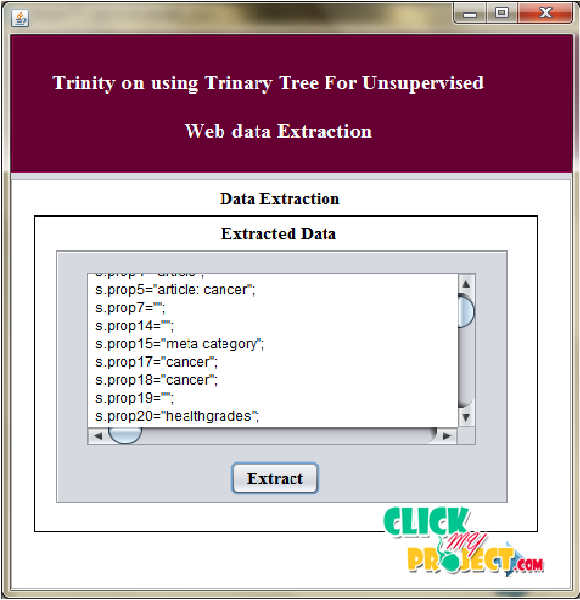
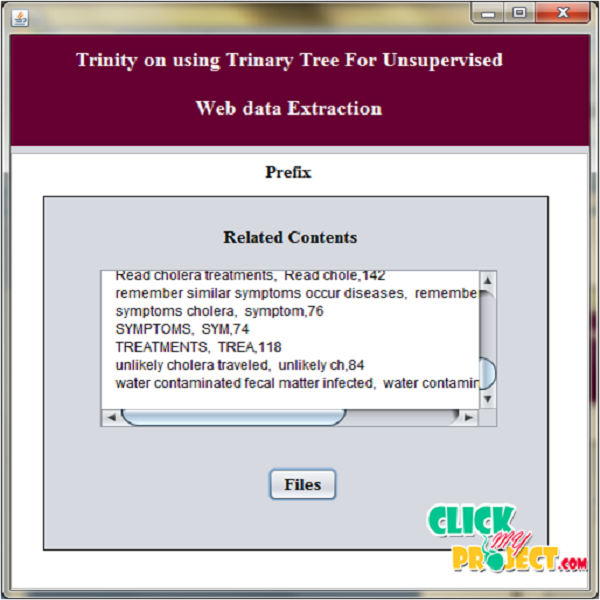
Technique which works on two or more web documents generated by same sever side template and learns a regular expression that models it and then used it for extracting data from similar documents. The technique introduces some shared pattern that do provide any relevant data . Data extraction from web through searching plays a major role now days. After extracting the web document making a search in that document will be difficult. Trinity search make use of ternary tree generation. Our proposal relies on two simple parameters that may introduce a bias in order to boost it performance. Our proposal performs better than the others and that its effectiveness does not depend at all on whether the input web documents are well- or malformed. The technique builds on the hypothesis that the model introduces some shared outlines that do not provide any appropriate data and can thus be overlooked. The costs involved in handcrafting ad-hoc rules enthused many researchers to work on offers to learn them automatically using supervised methods. The technique introduces some shared pattern that do provide any elevant data . The tree-based template matches the nature of the webpages but we only use two or three pages as an input. This paper evaluates the complementary nature between our tree kernel and a state – of – the – art linear kernel. Evaluation on the ACE RDC corpora shows that our dynamic context – sensitive tree span is much more suitable for relation extraction than SPT and our tree kernel outperforms the state – of – the -art Collins and Duffy ’ s convolution tree kernel It also shows that our tree kernel achieves much bet-ter performance than the state-of-the-art linear kernels. We search a word in a document and display the document in which the word mostly occurs in that document .
Tags: 2014, Data Mining Projects, Java