English
 Arabic


Description
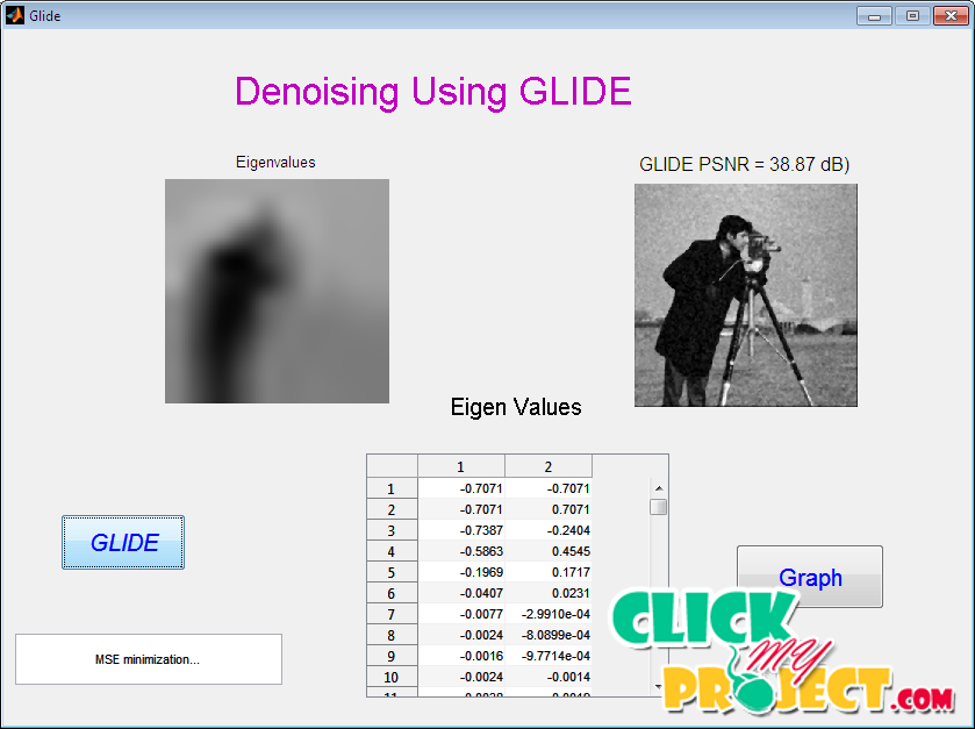
Image denoising is an important image processing task, both as a process itself and as a component in other processes. Very many ways to denoise an image or a set of data exists. The main properties of a good image denoising model is that it will remove noise while preserving edges. Traditionally, linear models have been used. Traditionally, linear models have been used. One common approach is to use a Gaussian filter, or equivalently solving the heat-equation with the noisy image as input-data, i.e. a linear, 2nd order PDE-model. For some purposes this kind of denoising is adequate. But a drawback of the linear models is that they are not able to preserve edges in a good manner: edges, which are recognized as discontinuities in the image, are smeared out. One popular model for nonlinear image denoising is the Total Variation (TV)-filter. While some denoising approaches such as the bilateral filter, LARK and NLM estimate each pixel separately fusing other “similar” neighborhood pixel. Some other recent state-of-the-art patch-based methods such as BM3D and PLOW denoise a group of similar patches together. This patch-based methods are inherently limited in performance Global denoising algorithm is to be proposed. It is non-local patch-based Processing where each pixel is estimated from all pixels in the image. Analysis of spectral decomposition of its parameter and computed an approximation to the spectral components using the Nystrom extension. Then the Sinkhorn method is applied to estimate the Eigen decomposition of the symmetric and double-stochastic filter. To get orthogonal eigenvectors, Sinkhorn result transferred to Orthogonalization procedure. This Global sample based filters approximation employed in a small fraction of the total number of pixels.