 English
 Arabic


In today’s Java Project fast-evolving digital ecosystem, the transportation sector is being reshaped by intelligent, software-driven solutions. For university students and aspiring developers, working on a real-world system related to mobility provides practical exposure to how modern applications are designed and deployed. A car rental management solution is an excellent learning platform, as it mirrors real business challenges such as user handling, data processing, and operational efficiency.
Designing a comprehensive car rental platform allows students to engage with advanced features like vehicle availability tracking, rental lifecycle management, and customer interaction workflows. Concepts such as fleet monitoring and automated reservations introduce learners to structured problem-solving, system architecture, and scalable design—skills that are essential for today’s software engineers.
For final-year students, this type of academic work bridges the gap between theory and real-world implementation. It encourages deeper understanding of application logic, database connectivity, and user interface development, while also strengthening analytical thinking and coding discipline required in professional environments.
At ClickMyProject, we focus on helping students succeed by offering well-structured, industry-relevant solutions with complete source code. Our approach emphasizes hands-on learning, enabling students to explore backend functionality, frontend workflows, and database integration in a clear and practical manner, building confidence and technical competence for their future careers.
The Importance of a Java Project in Modern Education
Choosing a Java project for your final year is a strategic move. Java’s “Write Once, Run Anywhere” philosophy makes it the ideal language for enterprise systems. When you develop a Car rental system using Java, you aren’t just writing code; you are learning how to manage memory, handle multi-threading, and implement secure data transactions.
A Java project of this scale typically involves:
- Object-Oriented Programming (OOP) serves as the foundation by transforming real-world elements into structured classes, such as vehicles, customers, and staff members. This approach improves code reusability, clarity, and long-term maintainability while supporting clean system architecture.
- Database connectivity is handled through JDBC, enabling seamless interaction with a MySQL database. This ensures that critical information—like user profiles, vehicle details, booking history, and availability status—is securely stored and easily retrieved whenever needed.
- To enhance usability, a graphical user interface is built using Swing or JavaFX. These frameworks help create an intuitive and responsive layout, allowing users and administrators to navigate features smoothly, manage records efficiently, and perform operations with minimal complexity.
For a final year student, a Java project serves as a bridge between classroom theory and the professional software development life cycle (SDLC).
Deep Dive into the Fleet Management System in Java
The core of this application is the fleet management system in Java. Without a robust way to track vehicles, a rental business cannot function. In this Java project, the fleet module is responsible for:
- Vehicle cataloging ensures that each car in the system is clearly identified through a unique ID, registration number, and assigned category such as Sedan, SUV, or Luxury. This structured classification makes it easier to organize the fleet, search records quickly, and maintain accurate vehicle details.
- Real-time status tracking plays a critical role in fleet operations by continuously updating whether a vehicle is available for rent, currently booked, undergoing maintenance, or scheduled for cleaning. This live visibility helps prevent double bookings and supports efficient allocation of vehicles.
- Maintenance scheduling adds an intelligent layer to fleet management by monitoring usage metrics like mileage. When a vehicle crosses a predefined threshold, the system automatically flags it for inspection or servicing, helping maintain safety standards, reduce breakdowns, and extend the overall lifespan of the fleet.
By mastering the fleet management system in Java, students learn how to manage collections and implement search/filter algorithms effectively.

Mastering the Booking Management System Java
If the fleet is the heart, then the booking management system Java module is the brain of the operation. This component handles the interaction between the user and the inventory. When building this part of your Java project, you must focus on:
- Availability Logic: Ensuring that a car cannot be booked by two different people for the same dates.
- Pricing Engine: Calculating the total cost based on daily rates, insurance add-ons, and seasonal discounts.
- Reservation Lifecycle: Managing the transition from “Pending” to “Confirmed” to “Completed.”
- Automated Notifications: Integrating email or SMS alerts to notify users of their booking status.
A well-coded booking management system Java demonstrates a student’s ability to handle complex business rules and date-time calculations.
Why Use Ready Made Java Projects with Source Code?
Many students ask why they should consider ready made Java projects with source code from platforms like ClickMyProject. The answer lies in the learning curve. Building from scratch is excellent, but analyzing a professionally structured Java project can accelerate your understanding of:
- Design Patterns: Seeing how the MVC (Model-View-Controller) pattern is applied in a real application.
- Error Handling: Learning how to use try-catch blocks effectively to prevent system crashes.
- Documentation: Understanding how to write a project report and SRS for a Java project for final year student requirements.
By starting with ready made Java projects with source code, you can focus on adding advanced features—like GPS tracking or mobile integration—rather than getting stuck on basic database connections.
Exploring Java Mini and Major Projects
At ClickMyProject, we categorize our offerings into Java mini and major projects.
- Java Mini Projects are designed to concentrate on a single, well-defined functionality, such as a basic login module, calculator, or simple data management feature. These smaller assignments help students grasp core programming concepts, logic building, and syntax usage. They are ideal for semester-end evaluations where clarity and correctness are more important than system complexity.
- By working on mini-level applications, learners gain confidence in problem-solving and coding fundamentals. These projects are quicker to develop, easier to understand, and serve as strong building blocks for tackling more complex systems later.
- Java Major Projects, on the other hand, involve end-to-end application development and integrate multiple modules into a unified system. Examples include full-featured solutions like a car rental management platform that combines user management, data storage, and workflow automation.
- Such large-scale implementations are well-suited for final-year submissions, as they showcase a deep understanding of programming concepts, system architecture, and real-world application design. They also reflect a student’s ability to handle complexity, integration, and professional-level development practices.
Whether you are looking for a Java project that uses Core Java or one that involves advanced frameworks like Spring and Hibernate, we provide the resources to help you succeed.
Technical Roadmap for a Successful Java Project
To ensure your Java project makes a strong impact during presentations and evaluations, following a structured technical roadmap is essential. Each stage below highlights critical development practices and explains their importance in building a robust, real-world system.
1. Requirements Analysis
The first step in any Java project is to clearly define what the software is expected to accomplish. This includes identifying core features such as user registration, booking workflows, payment handling, reporting modules, and administrative controls.
Asking the right questions at this stage—like whether online payments are required or if an admin dashboard should manage vehicles and users—helps set realistic boundaries and priorities for development.
Well-documented requirements act as a blueprint for the entire Java project, guiding design decisions and ensuring that the final outcome aligns with academic objectives and real-world use cases.
2. Database Schema Design
A carefully planned database structure is vital for smooth system operation in a Java project. Data should be organized into logical tables such as Users, Vehicles, Bookings, and Payments, each with clearly defined attributes.
Establishing proper relationships between tables using primary and foreign keys ensures data integrity and avoids redundancy. This structure also improves query performance and simplifies data management.
A strong schema design not only supports current functionality but also makes future expansion—such as adding reports or loyalty features—much easier to implement.
3. Developing the Backend
Backend development focuses on implementing the core logic that drives system behavior. Writing Data Access Objects (DAOs) in a Java project helps separate data-handling operations from business rules, resulting in cleaner and more maintainable code.
This separation improves readability and allows developers to modify database logic without affecting higher-level workflows like bookings or user validation.
A well-structured backend enhances scalability, simplifies debugging, and reflects professional development standards expected in enterprise-level Java projects.
4. UI/UX Development
User interface and experience play a major role in how a Java project is perceived. A clean layout, consistent design elements, and intuitive navigation make the application easier to understand and use.
Investing time in usability ensures that users can perform actions—such as searching vehicles or managing reservations—without confusion or unnecessary steps.
A polished interface often leaves a lasting impression on examiners, as it demonstrates attention to detail and a user-centric development approach.
5. Testing and Debugging
Testing is a critical phase in any Java project to ensure the system behaves reliably under different conditions. Unit and functional tests help validate individual components and overall workflows.
Special attention should be given to edge cases, such as invalid date selections, unavailable vehicles, or empty search results, which are common sources of errors.
Rigorous testing and systematic debugging lead to a stable, error-free Java project that performs confidently during demonstrations and real-world scenarios.

Frequently Asked Questions
1. Is a Car Rental System a good choice for a final year student?
Absolutely. It is a comprehensive Java project that demonstrates skills in CRUD operations, GUI design, and complex logic implementation.
2. Can I customize the fleet management system after purchasing?
Yes. All ready made Java projects with source code from ClickMyProject are fully customizable. You can add your own branding and features.
3. Does this software support multi-user access?
Yes, it is designed with role-based access control, allowing both admins and customers to use the system simultaneously.
4. What is the difference between Java mini and major projects?
A mini project is usually a smaller tool with limited scope, while a major project is a complete, multi-module application.
5. How do I run the source code for the booking management system?
You can import the files into any IDE like Eclipse or NetBeans, configure the MySQL database, and run the main class.
6. Why should I choose ClickMyProject for my Java project?
ClickMyProject provides verified, bug-free ready made Java projects with source code along with full technical documentation, making it the top choice for academic success.
7. Does ClickMyProject offer support for setting up the environment?
Yes, we provide guidance to ensure your files run smoothly on your local machine, including database configuration and environment setup.
Conclusion
The development of a Car Rental Management System is a rewarding journey that transforms a student into a developer. By focusing on a robust fleet management system in Java and a seamless booking management system Java, you create a tool that has real commercial potential.
For those who need a reliable starting point, ClickMyProject is your partner in excellence. Our extensive library of Java mini and major projects and ready made Java projects with source code ensures that every final year student can submit a Java project they are proud of. Start your journey today and master the art of software development.
Building a comprehensive car rental management solution is more than an academic exercise—it is a transformative experience that helps students evolve into confident, industry-ready developers. Throughout the development process, learners gain hands-on exposure to real-world problem solving, system design, and structured coding practices that closely mirror professional software environments.
By emphasizing a strong fleet management module and a smooth booking workflow, students learn how to design systems that balance performance, usability, and reliability. Managing vehicle availability, customer reservations, and operational logic provides valuable insight into how commercial transportation platforms function in practice.
Such an application also demonstrates real market relevance. A well-designed rental and booking platform has clear commercial potential, helping students understand how technical decisions directly impact business efficiency, customer satisfaction, and scalability in production-ready systems.
For those seeking a dependable foundation, ClickMyProject stands as a trusted partner in technical excellence. With a wide collection of mini and major academic solutions supported by complete source code, we help final-year students confidently present work they can be proud of—while building the skills needed to master modern software development.

The MERN stack comprising MongoDB, Express.js, React, and Node.js—is the undisputed champion of full-stack JavaScript development. A MERN STACK Project is more than just four separate technologies; it’s a unified, language-cohesive architecture designed for high-velocity development, seamless data flow, and ultimate scalability. For any modern developer, mastering the MERN STACK Project is the key to building applications that range from simple utilities to enterprise-level platforms handling millions of users.
This MERN ecosystem from its architectural foundation to the advanced techniques required for hyper-scale performance and bulletproof security. We will dissect the best practices for building an advanced MERN stack project, showcase essential readymade MERN stack project starter kits, and provide in-depth analysis on achieving production-readiness, with a focus on delivering a high-caliber MERN stack e-commerce project.
Part I: The Foundation – Understanding the MERN STACK Project Architecture
The inherent strength of a MERN STACK Project lies in its “JavaScript Everywhere” philosophy. This unified language across the client (React), the server (Node.js/Express.js), and the database (MongoDB, which uses a JSON-like format) minimizes context switching for developers, speeds up development cycles, and ensures data transfers are incredibly fluid.
1.1 MongoDB: The Flexible, Scalable Data Store (The ‘M’)
This structure aligns perfectly with JavaScript objects, eliminating the object-relational mapping (ORM) headache common in traditional stacks.
- Schema Flexibility: This feature is invaluable when embarking on a new MERN STACK Project or a prototype where data requirements are constantly changing. The schema can evolve without costly database migrations.
- Horizontal Scalability: MongoDB is designed to scale out (horizontal scaling) using a technique called Sharding, which distributes data across multiple servers. This is critical for any advanced MERN stack project expecting exponential user growth.
- Denormalization Strategy: Effective MongoDB schema design often leverages denormalization (embedding related data within a single document) to minimize the number of queries needed to fetch complete data, drastically improving read performance.
1.2 Express.js and Node.js: The Non-Blocking Backend (The ‘E’ and ‘N’)
Node.js is the cross-platform JavaScript runtime environment that executes JavaScript code outside a web browser, forming the server-side backbone of every MERN STACK Project. Express.js is a minimalist, fast, and unopinionated web framework for Node.js, designed to build robust APIs.
- Event-Driven Architecture: Node.js operates on a single-threaded, event-loop model. This non-blocking I/O (Input/Output) is its superpower. Instead of waiting for a database query or an external API call to complete (blocking), Node.js processes the next request and executes the callback when the I/O operation finishes. This makes the MERN STACK Project server highly efficient for I/O-heavy tasks like real-time chat or an API handling thousands of concurrent users.
- RESTful API Implementation: Express.js provides the tools to define routes, handle HTTP methods (GET, POST, PUT, DELETE), and integrate middleware for tasks like logging, authentication, and security. It is the crucial middle layer that translates requests from the React client into actions for MongoDB.
1.3 React: The Component-Driven Interface (The ‘R’)
It is the public face of the MERN STACK Project, responsible for delivering a fast, responsive, and intuitive user experience.
- Component Reusability: React promotes building UIs from isolated, reusable components. This modularity is a foundational best practice, especially when tackling a large-scale advanced MERN stack project like a complex MERN stack e-commerce project.
- The Virtual DOM: React maintains a lightweight representation of the actual DOM (the Virtual DOM). When application state changes, React first updates the Virtual DOM, compares it to a previous version, and only updates the specific, necessary nodes in the actual browser DOM. This optimization is why React applications feel so fast and smooth.
- Modern State Management: While the built-in useState and useContext hooks are sufficient for simple components, large MERN STACK Project applications often employ sophisticated state management patterns using libraries like Redux Toolkit or Zustand to ensure predictable data flow across complex component trees.
Part II: Advanced MERN STACK Project Design Patterns
Moving beyond basic CRUD operations requires adopting established architectural patterns that ensure a MERN STACK Project remains scalable, maintainable, and testable as it grows.
2.1 The Service/Repository Pattern in Express
For any advanced MERN stack project, simply putting business logic directly into the Express route controllers is a recipe for “fat controllers” and spaghetti code. The Service/Repository Pattern separates concerns into distinct layers:
- Controller Layer (Express Routes): Handles request/response logic, parsing input, and calling the service layer.
- Service Layer (Business Logic): Contains all core application logic (e.g., calculating taxes, applying discounts, validation). It is independent of the database.
- Repository/Data Access Layer (DAL): Deals exclusively with the database (MongoDB/Mongoose), handling query construction, indexing, and data fetching.
Benefits: This structure makes unit testing simple (testing the service layer without involving the actual database) and allows for easier migration to a different database in the future.
2.2 Microservices Architecture with MERN
For truly massive applications, like a global MERN stack e-commerce project, a single monolithic MERN STACK Project backend can become a bottleneck. Microservices architecture decomposes the application into a collection of smaller, independent services, each responsible for a single business domain
- Technology Agnostic: While Express/Node.js is great, a microservices approach allows the developer to choose the best technology for each service (e.g., using Python for a high-computation recommendation engine).
- Communication: Services often communicate via lightweight protocols like REST, or more commonly, via a message broker such as RabbitMQ or Kafka for asynchronous, event-driven communication.
2.3 Server-Side Rendering (SSR) and Static Site Generation (SSG)
While React typically renders on the client side, this can hurt initial load time and SEO performance. Solutions like Next.js (built on React) provide powerful alternatives:
- Server-Side Rendering (SSR): The React component is rendered to HTML on the Node.js server for each request. This sends fully formed HTML to the browser, improving initial load speed and making the content visible to search engine crawlers—essential for a content-heavy MERN STACK Project like a blog or a vast MERN stack e-commerce project.
- Static Site Generation (SSG): Pages are pre-rendered into static HTML files at build time. This is the fastest method, perfect for pages that don’t change often (like product detail pages or marketing pages).
Part III: Bulletproofing Your MERN STACK Project
Security is a development discipline, not an afterthought. For any professional-grade MERN STACK Project, especially those handling sensitive user or financial data, implementing robust security measures is paramount.
3.1 Secure Authentication and Authorization
- JSON Web Tokens (JWT): The standard for authentication in the MERN STACK Project. Express/Node.js generates a signed JWT upon successful login.
- Secure Storage: Crucially, tokens should be stored in HttpOnly cookies. This prevents client-side JavaScript (and malicious XSS scripts) from accessing the token, a significant security win.
- Expiration and Rotation: Use short-lived access tokens (minutes) combined with refresh tokens (days) to limit the window of opportunity for an attacker if a token is compromised.
- Password Hashing: Never store plain text passwords. Use a slow, computationally intensive hashing function like bcrypt (with a sufficient number of salt rounds, e.g., 10-12) or Argon2 to securely hash and salt passwords before storing them in MongoDB.
- Role-Based Access Control (RBAC): Implement middleware in Express.js that checks the user’s role (e.g., user, admin, moderator) from the JWT payload before allowing access to a route. This ensures an authenticated user cannot access unauthorized endpoints (e.g., a standard user cannot access the admin product-creation API).
3.2 Database and API Protection
- Input Validation and Sanitization: This is the primary defense against injection attacks.
- Server-Side Validation (Express): All data received from the React front-end must be validated and sanitized on the back-end using libraries like Joi or Zod to ensure the data matches the expected schema and type. This prevents malicious payloads.
- NoSQL Injection: Libraries like Mongoose, when used correctly with parameterized queries, help mitigate direct NoSQL injection by ensuring user input is treated as data, not as a MongoDB operator.
- HTTP Headers and Middleware: Use Express middleware like Helmet.js to automatically set secure HTTP headers, protecting the application from common web vulnerabilities such as:
- XSS Protection: Setting the X-XSS-Protection header.
- Clickjacking: Using X-Frame-Options to prevent the site from being embedded in a frame.
- Content Security Policy (CSP): Defining trusted sources of content (scripts, styles) to mitigate XSS attacks.
- Rate Limiting: Implement rate-limiting middleware (e.g., express-rate-limit) on sensitive routes (login, registration, password reset) to prevent brute-force attacks and denial-of-service (DoS) attacks.

Part IV: The Portfolio Builders – Best MERN STACK Project Ideas
Building a powerful portfolio requires selecting projects that demonstrate mastery of key MERN concepts, ranging from real-time communication to complex payment flows. While access to MERN stack projects with source code is helpful, the true value lies in unique implementation.
4.1 The Advanced MERN STACK Project Showcase
| Project Category | MERN STACK Project Idea | Key Feature Demonstrations |
| Real-Time | Collaborative Code/Document Editor | WebSockets (Socket.io) for live sync, Complex state management (Redux/Zustand), Debouncing/Throttling of database writes. |
| FinTech | Personalized Budgeting/Investment Dashboard | Third-party API integration (e.g., Plaid, financial data APIs), Advanced data visualization (D3.js, Chart.js), Role-based access for shared household budgets. |
| Community/Marketplace | Localized Service Marketplace (TaskRabbit clone) | Geo-spatial querying in MongoDB (2dsphere indexes), Real-time chat (Socket.io) for buyer-seller communication, Secure payment escrow system. |
| Media/Data | Video Content Management System (V-CMS) | Large file upload handling (S3/Cloudinary), Video transcoding via external workers/queues (BullMQ), Search indexing (Elasticsearch/Algolia) for content discovery. |
4.2 The Ultimate MERN STACK Project: MERN Stack E-commerce Project
The MERN stack e-commerce project remains the single most comprehensive demonstration of full-stack skill. It inherently covers all four MERN components in depth.
- React Frontend: Product filtering (by category, price, rating), client-side cart management (using global state), dynamic routing for product detail pages, and responsive design.
- Express/Node.js Backend: RESTful APIs for product retrieval, a complex authentication system (user and admin roles), secure webhook handling for payment gateway updates.
- MongoDB Database: Complex schema design involving product, user, order, and review collections. Advanced queries for inventory checks and aggregating product ratings.
- Payment Integration: Integrating with a processor like Stripe or PayPal, which requires the Node.js back-end to handle the payment intent securely, ensuring that all financial transactions are performed server-side.
This project, when executed correctly, showcases mastery of an advanced MERN stack project architecture.
Part V: Scaling and Performance Optimization for the MERN STACK Project
A highly performant MERN STACK Project delivers a superior user experience, improving retention and lowering operational costs. Scaling involves optimizing all four layers.
5.1 MongoDB Optimization Strategies
- Indexing: The most crucial optimization. Create indexes on all fields used in query filters, sorts, and projections. Use compound indexes for queries involving multiple fields to avoid slow collection scans.
- Query Projection: Use projection to retrieve only the fields needed from the database. Avoid fetching entire large documents if only one or two fields are required.
- Caching with Redis: For highly read-heavy data (e.g., product listings in an e-commerce project), integrate a fast in-memory cache like Redis. Express.js checks Redis first before making a slower call to MongoDB.
- Sharding (For Hyper-Scale): When a single MongoDB replica set cannot handle the load, implement sharding to distribute data across multiple independent clusters, enabling true horizontal scaling.
5.2 Express/Node.js Scaling and Efficiency
- Clustering: Since Node.js is single-threaded, a single server instance cannot utilize all CPU cores on a machine. The Node.js Cluster Module or tools like PM2 allow you to fork multiple worker processes, enabling your MERN STACK Project to leverage every available core, dramatically increasing throughput.
- Gzip Compression: Use the compression middleware in Express to compress response bodies for all API calls. This reduces the size of data traveling over the network, leading to faster load times, especially for the React client.
- Load Balancing: Deploy the application behind a Load Balancer (e.g., Nginx, or a cloud provider’s load balancer) to distribute incoming traffic evenly across the clustered Node.js instances.
5.3 React Frontend Performance Tuning
- Code Splitting and Lazy Loading: Use dynamic import() and the React.lazy() and <Suspense> components to split the application into smaller bundles. Components (and the JavaScript needed to render them) are only loaded when they are needed by the user, drastically reducing the initial page load time.
- Memoization: Prevent unnecessary re-renders of components. Use React.memo for functional components and the useMemo and useCallback hooks for optimizing expensive computations or preventing unnecessary function re-creations.
- Image Optimization: Implement lazy loading for images that are below the fold and ensure images are compressed and served in modern formats (like WebP) to minimize asset size.

Part V: Project Management and Deployment Strategies
A successful MERN STACK Project is not just about code; it’s about the pipeline that takes that code to production.
6.1 The CI/CD Pipeline
Continuous Integration/Continuous Deployment (CI/CD) automates the process of testing and deploying the MERN STACK Project.
- Continuous Integration (CI): Every code push triggers automated unit/integration tests (using Jest or Mocha/Chai) and code linting (using ESLint/Prettier). This catches bugs early.
- Continuous Deployment (CD): Once tests pass on the main branch, the process automatically builds the React client and the Node.js server, containers them (using Docker), and deploys them to the production environment. This ensures faster, more reliable updates.
6.2 Containerization and Orchestration
- Docker: Containerize your application. A typical MERN STACK Project requires three containers: one for the React client, one for the Express/Node.js server, and one for the MongoDB database. Docker ensures that the environment is consistent from development to production (“it works on my machine” is eliminated).
- Orchestration (Kubernetes): For large-scale applications, Kubernetes manages the lifecycle, scaling, and health of these containers. It handles rolling updates, self-healing, and traffic routing, crucial for maintaining uptime in an advanced MERN stack project.
Frequently Asked Questions
FAQ 1: How does a readymade MERN stack project accelerate development without compromising long-term quality?
A quality readymade MERN stack project accelerates development by providing a production-ready boilerplate structure, saving hundreds of hours on initial configuration, security setup (like JWT and HTTPS), and deployment scripts. The key is choosing one that prioritizes modularity and follows patterns like the Service/Repository separation. This structure ensures that as you add custom business logic, the code remains clean, maintainable, and scalable, preventing the initial time-save from becoming a long-term technical debt nightmare. The best MERN stack projects with source code should be used as foundations, not final products.
FAQ 2: What are the key architectural differences between a standard MERN STACK Project and a true advanced MERN stack project that is production-ready?
A standard MERN STACK Project focuses on functionality (CRUD operations). A true advanced MERN stack project focuses on scalability, resilience, and security.
| Feature | Standard MERN STACK Project | Advanced MERN STACK Project (Production-Ready) |
| Server | Single Express/Node instance. | Clustered Node.js instances behind a Load Balancer. |
| Authentication | JWT in local storage. | JWT in HttpOnly cookies with refresh token rotation. |
| Database | Basic Mongoose queries. | Indexed queries, Redis caching layer, potential MongoDB Sharding. |
| Deployment | Manual deployment. | Fully automated CI/CD pipeline with Docker/Kubernetes. |
| State | React Context or simple Redux. | Redux Toolkit for complex state, Data Fetching Libraries (e.g., React Query). |
FAQ 3: Why do students and developers prefer ClickMyProject for MERN Stack Project guidance instead of building everything in-house?
Students and developers choose ClickMyProject for their MERN Stack Project guidance because the platform delivers expert-level support, production-ready architecture, and high-quality project resources that go far beyond regular in-house development. While learners may focus on basic functionality, ClickMyProject provides advanced optimization techniques, clean code structures, secure authentication modules, and scalable architecture patterns that match real industry standards. The team also ensures every project includes proper documentation, error-free execution, and practical demonstrations, giving final year students a strong foundation to build professional applications with confidence.
FAQ 4: How does ClickMyProject ensure that MERN stack e-commerce projects delivered to students follow high-performance and secure payment standards?
ClickMyProject ensures that every MERN stack e-commerce project meets strong performance and payment security requirements by integrating reliable and industry-approved methods. All payment flows are structured using secure server-side implementations, ensuring sensitive data never reaches the client browser. The backend handles payment intent creation and verification with trusted gateways, making the transaction process both fast and highly secure. Real-time update handlers, order verification modules, and safe callback processing are included to help students understand how professional e-commerce systems function smoothly without transactional delays or failures. This level of implementation gives final year students a strong understanding of real-world payment workflows.
FAQ 5: Is it better to use GraphQL or traditional REST for an advanced MERN stack project?
The choice between GraphQL and REST depends on the project’s complexity.
- REST (Traditional MERN): Excellent for simple, resource-centric APIs. It’s easy to cache and is the default for most MERN STACK Project solutions.
- GraphQL (Advanced MERN): Superior for complex applications where the client needs to request specific data fields from multiple related resources in a single call. This solves the “over-fetching” or “under-fetching” problem common with REST
Conclusion:
The MERN STACK Project is not a trend; it is the established paradigm for developing modern web applications. Its power lies in the unified JavaScript ecosystem, offering a streamlined development experience from the NoSQL flexibility of MongoDB, through the non-blocking efficiency of Node.js and Express.js, to the component-driven speed of React.
To truly master the stack, developers must transcend simple functionality. The focus must shift to architectural resilience—designing for horizontal scaling, implementing patterns like the Service/Repository layer, and rigorously enforcing security best practices at every layer of the application. Whether prototyping with a well-vetted readymade MERN stack project or delivering a feature-rich, high-transaction MERN stack e-commerce project, the dedication to modularity and optimization will determine success.
An advanced MERN stack project is one that not only functions but scales, secures, and performs under immense pressure, proving the developer’s capability to build the next generation of web platforms. Embracing tools like Docker, CI/CD, and Redis caching transforms a working application into a production powerhouse, cementing the MERN STACK Project as the indispensable skill set for the future.

A Web application project is, at its core, a software program that runs on a server and is accessed by users through a web browser. Unlike traditional desktop software, Web application projects require no user installation and can be accessed from any device with an internet connection, making them inherently scalable and globally accessible. The versatility of Web application projects is what makes them so ubiquitous and vital. They power everything from customer relationship management (CRM) systems to interactive educational platforms and sophisticated data analysis tools.
The digital ecosystem thrives because of these Web application projects. They bridge the gap between abstract computing power and tangible user utility. Learning how to successfully execute Web application projects involves more than just coding; it requires an understanding of user experience, database management, security protocols, and general cloud deployment strategies.
For those looking to excel in the field of technology, creating a portfolio of strong Web application projects is non-negotiable. Whether you are aiming for a career as a full-stack developer or preparing for final year web application projects submissions, the ability to build functional, polished Web application projects is the ultimate metric of competency. Throughout this guide, we will repeatedly underscore the importance of selecting, planning, and executing effective Web application projects that meet real-world needs. We will also specifically address the category of simple web application projects, which serves as the essential starting point for every journey into web development.
II. The Anatomy of Web application projects
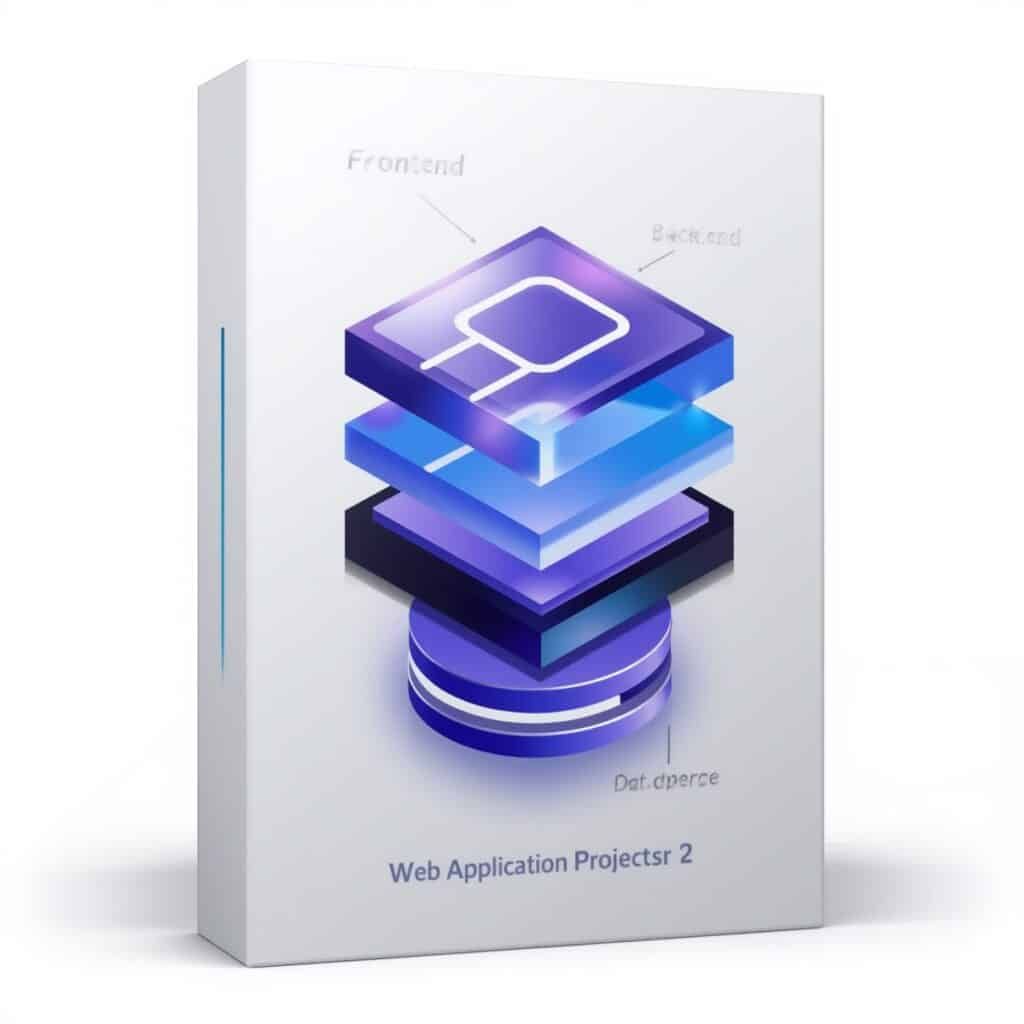
Every substantial Web application project adheres to a fundamental architectural model, typically known as the client-server model. Understanding these structural components is the first step toward building successful Web application projects. These components, often referred to as the ‘stack,’ are traditionally broken down into three layers: the Frontend (client-side), the Backend (server-side), and the Database (data storage). The interplay between these three elements dictates the functionality, speed, and reliability of all Web application projects.
A. Frontend
The frontend is the part of the Web application project that the user sees and interacts with directly in their browser. It is the crucial interface for any Web application project, determining user adoption and satisfaction. It is built primarily using three core languages: HTML (HyperText Markup Language) for structure, CSS (Cascading Style Sheets) for styling and presentation, and JavaScript for interactivity and dynamic behavior.
Modern Web application projects rarely rely on vanilla JavaScript alone. Instead, developers utilize powerful frontend frameworks and libraries such as React, Vue.js, or Angular. These tools allow for the creation of complex, single-page applications (SPAs) that offer a seamless, desktop-like experience within a browser. Building responsive design into all Web application projects—ensuring they function perfectly on mobile devices, tablets, and desktops—is a mandatory requirement in today’s development environment. The success of a Web application project often hinges on how intuitive and fast its frontend
B. Backend
The backend is the engine room of the Web application project. It is responsible for handling the logic, calculations, security, and communication with the database. When a user interacts with the frontend (e.g., clicking a login button), the request is sent to the backend server. The server processes this request, executes the necessary business logic, retrieves or updates data, and sends the appropriate response back to the frontend.
Popular technologies for building the backend of Web application projects include Python (with frameworks like Django and Flask), Java (with Spring Boot), Node.js (with Express.js), and PHP (with Laravel or Symfony). The choice of technology for a Web application project often depends on factors like scalability requirements, existing team expertise, and the complexity of the processing needed. For example, high-performance or enterprise-level Web application projects might favor Java, while rapid development and data science applications might lean toward Python. Regardless of the language, the backend’s job is to ensure the Web application project runs securely and efficiently.
C. Database
The database is where all persistent data for the Web application project is stored. This includes user profiles, content, transactions, settings, and every piece of information the application needs to operate. Without a robust database, a Web application project cannot retain state or information across user sessions.
Databases fall broadly into two categories for Web application projects:
- SQL (Relational) Databases: These use structured schemas and defined relationships (e.g., PostgreSQL, MySQL, SQL Server). They are excellent for Web application projects that require strict data integrity and complex transactions (like financial or e-commerce applications).
- NoSQL (Non-relational) Databases: These are more flexible, storing data in formats like documents (MongoDB), key-value pairs (Redis), or graphs. They are ideal for Web application projects that need rapid scaling, handle large volumes of unstructured data, or require frequent schema changes.
Selecting the right database is a critical architectural decision for any Web application project, directly impacting its long-term performance and maintainability.
III. Categorizing Web application projects for Different Goals
The universe of Web application projects is vast and varied, but they can be functionally categorized based on their purpose, target audience, and complexity. Understanding these categories—especially the differences between readymade web application projects, final year web application projects, and trending web application projects—is essential for making informed decisions about your development path.
A. Readymade Web application projects
The category of readymade web application projects refers to pre-built, packaged solutions or existing source code that is ready for deployment or minor customization. These projects are often developed to solve common business or academic problems and are sold or provided to allow users to quickly acquire a fully functional application. The key characteristic of readymade web application projects is speed and demonstrable functionality.
- When to Use Readymade Web application projects:
- Prototyping: They serve as excellent starting points, providing a foundation that can be quickly customized for a proof-of-concept.
- Learning: Analyzing a complete, functional Web application project is an invaluable educational tool. Beginners can dissect the code structure, database schema, and deployment process without building from scratch.
- Quick Deployment: For businesses needing a standard solution immediately (e.g., a simple HR portal or inventory system), readymade web application projects offer a substantial time-to-market advantage.
While highly efficient, using readymade web application projects comes with caveats. Developers must ensure they have the rights to the code and that the structure is well-documented. Furthermore, relying on readymade web application projects for academic work requires careful consideration; while they provide context, final year web application projects often require a substantial component of original work. Nevertheless, for accelerating the development lifecycle, readymade web application projects are a powerful option in the developer’s toolkit. They allow teams to focus less on boilerplate code and more on unique feature integration. The availability of diverse readymade web application projects highlights the maturity and modular nature of the web development ecosystem.
B. Final Year Web application projects
For students, final year web application projects represent the culmination of years of study. These projects are not just technical exercises; they are an opportunity to demonstrate mastery across the entire spectrum of software development, including research, design, implementation, and rigorous documentation. Final year web application projects demand innovation and relevance, often pushing the boundaries of current technology.
A successful final year web application project must meet high criteria:
- Novelty and Complexity: The project must solve a unique problem or offer a significantly improved solution over existing systems. Simple CRUD (Create, Read, Update, Delete) applications are generally insufficient; the best final year web application projects incorporate advanced algorithms, emerging technologies, or complex logic.
- Implementation Quality: Clean, modular code, efficient database design, robust error handling, and comprehensive security measures are essential components of high-scoring Web application projects.
- Documentation: Detailed reports, including requirements analysis, design specifications
- AI/ML Integration in Web application projects: Building systems that incorporate machine learning models for tasks like predictive analysis (e.g., stock market prediction, crop yield forecasting) or intelligent content filtering. A Web application project that classifies images or predicts trends based on user data demonstrates cutting-edge skills.
- Big Data and Data Mining Web application projects: Developing a Web application project that processes and visualizes large datasets, perhaps offering novel data mining techniques for business intelligence or academic research. These projects require expertise in handling massive throughput and complex analytical queries.
- Security-focused Web application projects: Creating a robust system that explores new authentication methods (e.g., risk-based authentication), secure communication protocols, or tools for vulnerability assessment and penetration testing. The focus here is on securing the integrity of the data within the Web application project.
The key to succeeding with final year web application projects is meticulous planning. Students must choose a domain they are passionate about and ensure the scope is manageable within the project timeline. Leveraging modern frameworks like Django (Python) or Spring (Java) for the backend and React or Vue for the frontend can significantly enhance the complexity and polish of the resulting Web application projects. The rigor associated with final year web application projects serves as invaluable training for a professional development career.
C. Trending Web application projects
Staying current with the latest technological shifts is paramount for developers building modern Web application projects. Several key trends are defining the next generation of online applications, offering exciting opportunities for innovation. Incorporating these into your portfolio ensures your Web application projects remain relevant.
- Progressive Web Apps (PWAs): These are Web application project that leverage modern browser capabilities to deliver an app-like user experience. They are fast, reliable (working offline), and installable on the user’s home screen, bypassing traditional app stores. Building a PWA as a Web application project demonstrates an understanding of service workers, manifest files, and responsive design principles.
- Blockchain and Decentralized Web application projects : While still a niche, dApps represent the cutting edge. They are Web application project where the backend logic runs on a decentralized network (a distributed ledger). Creating a simple decentralized identity service or a voting application demonstrates proficiency in web3 technologies and smart contract development (often using Solidity).
- Serverless Architecture: This paradigm involves building Web application project without managing the underlying servers. Services like Google Cloud Functions or similar platform solutions automatically handle scaling and infrastructure. Developing a Web application project that utilizes functions-as-a-service dramatically reduces operational complexity and showcases an understanding of cost-efficient, auto-scaling deployment models.
- AI-Powered Personalization: Integrating AI into Web application project to personalize user experiences is a major trend. This could involve building recommendation engines, automated customer service chatbots, or dynamic content generation tools. These highly sophisticated Web application projects are quickly becoming the industry standard.

IV. Mastering Simple Web application projects
The path to building complex, enterprise-level Web application projects begins with mastering simple web application project. These foundational exercises are crucial for solidifying core concepts, understanding the full development lifecycle, and gaining confidence with development tools. Every seasoned developer started by successfully completing simple web application project.
A. Simple Web application projects: Why Simplicity is Key
The goal of a simple web application project is not to impress with complexity, but to flawlessly execute fundamental building blocks. Beginners often make the mistake of attempting too much too soon, leading to burnout and unfinished work. By starting with simple web application project, you can focus on one concept at a time:
- Focusing on Fundamentals: A simple web application project allows you to concentrate on basic HTML form handling, the nuances of client-side JavaScript logic, or the pure execution of a CRUD operation without the distraction of complex security configurations.
- Rapid Iteration: You can build, test, and deploy a simple web application project much faster, providing the immediate feedback loop necessary for effective learning.
- Bridging Theory and Practice: The theory learned in textbooks—HTTP requests, event handlers, DOM manipulation—becomes concrete when applied to a simple web application project like a calculator or a basic task tracker.
Successfully completing multiple simple web application project builds a robust understanding that is essential when tackling more ambitious Web application project, such as those involved in final year web application project or commercial ventures.
B. 10 Essential Simple Web application projects Ideas
Here is a list of highly effective simple web application projects designed to reinforce different fundamental skills:
- To-Do List/Task Tracker: This is arguably the most foundational simple web application project. It teaches basic form input, local storage management (to save tasks across sessions), and DOM manipulation (to dynamically add and remove tasks). It’s perfect for understanding basic state management.
- Simple Calculator: Focuses entirely on client-side JavaScript logic. The complexity lies in handling operator precedence and chained calculations. It’s a classic example of a simple web application project demonstrating numerical processing.
- Weather App: This project introduces the concept of External APIs. It is a simple web application project that involves making an asynchronous request (using fetch or Axios) to a public weather API, handling the JSON response, and presenting the data visually to the user.
- Recipe Finder: A step up from the weather app, this simple web application project uses a recipe database API. The core challenge is implementing basic search functionality and filtering results based on user input or dietary preferences.
- Basic Blog/CMS (Content Management System): This is the first step toward a full-stack simple web application project. It requires a database to store posts and comments and involves setting up basic routing (e.g., /posts/1, /about). It is a practical demonstration of how Web application project manage content.
- URL Shortener: A slightly more advanced simple web application project that requires backend work. The server must accept a long URL, generate a unique short code, store the mapping in a database, and perform a 302 redirect when the short code is accessed.
- Quiz Application: Excellent for learning sophisticated state management and event handling. The simple web application project must track the current question, the user’s answer, a timer, and calculate a final score, providing instant feedback.
- Landing Page Generator: This focuses heavily on the frontend. The simple web application project allows users to input text and select colors/fonts, and it generates a basic HTML/CSS landing page snippet they can copy. It emphasizes design and output generation.
- Contact Form Processor: A vital piece of any Web application project. This project focuses on secure server-side handling of form data, including validation, sanitization, and sending the collected data via email (using a service like SendGrid) or storing it in a small database.
- Markdown Previewer: This simple web application project takes plain text input written in Markdown format and instantly renders the output as formatted HTML, teaching fundamental text manipulation and rendering libraries.
By completing these simple web application projects, the developer builds muscle memory for core programming concepts, laying the groundwork for complex Web application projects.
C. Step-by-Step Development of a Simple Web application project (The To-Do List Example)
Let’s detail the process of building the To-Do List, a quintessential example of a simple web application project, to illustrate the development lifecycle.
Phase 1: Planning and Design
Even the most simple web application project benefits from planning.
- Requirements: Users must be able to: a) Add new tasks. b) Mark tasks as complete. c) Delete tasks. d) See existing tasks upon returning (Persistence).
- Stack: We will use HTML/CSS/JavaScript for the frontend and a basic local storage mechanism for data persistence, keeping the server out of this simple web application project for maximum speed and simplicity.
Phase 2: Frontend Implementation
- HTML Structure: Create the necessary elements: an input field (<input type=”text”>), an “Add” button (<button>), and an unordered list (<ul>) to display the tasks. This is the structural backbone of the Web application project.
- CSS Styling: Apply basic styling to make the simple web application project visually appealing and responsive. Ensure the layout is clean, and the input area is prominent.
- JavaScript Interactivity:
- Event Listeners: Attach an event listener to the “Add” button to capture the text input when clicked.
- DOM Manipulation: Create a new list item (<li>) when a task is added. Include elements within the <li> for the task text and a “Delete” button. This is where the Web application project becomes dynamic.
Phase 3: Adding Persistence to the Simple Web application project
The critical step that transforms a basic script into a true Web application project is persistence. We achieve this using the browser’s Local Storage API:
- Saving Data: Whenever a task is added, deleted, or marked complete, update the JavaScript array of tasks and then use localStorage.setItem(‘tasks’, JSON.stringify(taskArray)) to save the data.
- Loading Data: When the simple web application project loads, check for existing data: localStorage.getItem(‘tasks’). If data exists, parse the JSON back into a JavaScript array and iterate through it, dynamically creating the <li> elements to display the tasks.
Phase 4: Refinement and Deployment
- Error Handling: Add input validation (e.g., prevent the addition of empty tasks). This makes the simple web application project more robust.
- Code Optimization: Refactor the JavaScript code into clean, reusable functions (e.g., renderTasks(), addTask(), saveTasks()).
- Deployment: Deploy the finished files (HTML, CSS, JS) to a free static hosting service like Netlify or GitHub Pages. This completes the development cycle for the simple web application project, turning it into a publicly accessible Web application project.
This methodical approach to even a simple web application project instills the discipline required for managing much larger Web application project in the future, providing a solid, verifiable entry for any developer’s portfolio.

V. Development and Deployment Strategies for Professional Web application project
Moving beyond simple web application projects to professional-grade systems requires adopting industry best practices in security, scalability, and deployment automation. These strategies ensure that Web application projects can withstand heavy traffic, remain secure against threats, and evolve efficiently over time.
A. Security Best Practices for all Web application projects
Security is not a feature; it is a fundamental requirement for all Web application project. Neglecting security is the fastest way to doom a project. Developers must be acutely aware of vulnerabilities outlined by organizations like the OWASP (Open Web Application Security Project).
Key security practices for Web application projects include:
- Input Validation and Sanitization: All user input must be treated as malicious. Implementing strict validation prevents injection attacks SQL, command and Cross-Site Scripting .
- Secure Authentication: Never store passwords in plain text. Use strong hashing algorithms and modern authentication flows
- API Security: Implement rate limiting to prevent denial-of-service attacks and ensure all sensitive API endpoints are protected by appropriate authorization checks.
- Use of HTTPS: Encrypting all data transmission between the client and server is mandatory for any modern Web application project.
By embedding these security protocols from the initial stage, developers ensure they are building trustworthy and resilient Web application projects.
B. Scalability and Performance Optimization
A successful Web application project must be able to handle growth—scaling from a few users to millions. Scalability is the measure of a system’s ability to increase its output under an increased load.
- Horizontal Scaling: The primary method for most Web application project, involving adding more servers (web, database, or application) to distribute the load. This is facilitated by technologies like load balancers.
- Database Optimization: As the heart of the Web application project, the database is often the bottleneck. Techniques like indexing, query optimization, and database sharding are crucial.
- Caching: Implementing layers of caching (Content Delivery Networks or in-memory caching like Redis) dramatically improves the performance of Web application project by storing frequently accessed data and reducing the need for repeated database lookups.
- Code Efficiency: Efficient algorithms and optimized code execution minimize the time spent processing requests, ensuring the Web application project remains responsive even under high load.
C. DevOps and CI/CD for modern Web application projects
The modern development of Web application projects relies heavily on automation through DevOps practices and Continuous Integration/Continuous Deployment (CI/CD) pipelines.
- Continuous Integration (CI): This means developers integrate code into a shared repository frequently. Automated builds and tests are run to immediately detect errors. This ensures the codebase for the Web application project is always in a working state.
- Continuous Deployment (CD): Once code passes automated tests, it is automatically deployed to staging or production environments. Tools like Jenkins, GitLab CI, or GitHub Actions automate this entire process.
- Infrastructure as Code (IaC): Using tools like Terraform or Ansible to define the infrastructure (servers, networks, databases) as code. This makes the deployment of the Web application project repeatable, scalable, and version-controlled.
Automating the deployment of Web application projects reduces human error, increases deployment frequency, and allows development teams to focus more on feature creation.
D. Testing: Unit, Integration, and End-to-End Testing for robust Web application projects
Testing is the guarantee of quality for any Web application project. A robust testing strategy ensures reliability, especially as the project scales beyond simple web application project
- Unit Tests: Focus on testing the smallest, isolated units of code (e.g., a single function or method). They are fast to run and pinpoint exact errors in the logic of the Web application project.
- Integration Tests: Verify that different modules or services within the Web application project interact correctly (e.g., ensuring the backend service successfully communicates with the database).
- End-to-End (E2E) Tests: Simulate a real user journey through the entire Web application project (e.g., a user logging in, adding an item to a cart, and checking out). Tools like Cypress or Selenium are essential for E2E testing of Web application projects.
A comprehensive test suite is an investment that saves enormous time and resources in the long run, guaranteeing that any deployed Web application project provides a stable user experience.
VI. Frequently Asked Questions
1. What is the single most important skill for developing successful Web application projects?
The key skill for Web application projects is strong problem-solving and logical thinking. Coding only works when the logic is clear. Good developers can understand a problem, break it into simple steps, plan the solution, and predict issues early. This skill is important for both small web apps and large systems.
2. How long does it take to build a basic simple web application project?
A simple web application project like a calculator, portfolio site, or basic weather app can be completed in a day if the developer knows HTML, CSS, and JavaScript well. If the project has a backend, it may take 3 to 5 days for planning, coding, and testing. The key is keeping the project small and simple.
3. Where can I find support and source code for my final year web application projects?
Students can use GitHub and coding forums for free help with web application projects. But for organized, domain-specific support, especially in advanced areas, services like ClickMyProject are useful because they provide ready-made ideas, source code, and documentation.
4.What specific technologies do ClickMyProject offer for their Web application projects?
ClickMyProject offers Web application projects in many languages and domains to match academic and industry needs. Students can choose projects in Java, Python, PHP, or .NET, and domains like Machine Learning, Data Mining, Cloud Computing, Web Services, and Network Security. They also provide projects with mobile and database technologies, making it easy for students to find a project that fits their specialization.
5.Are the Web application projects provided by ClickMyProject suitable for academic submission?
Yes, ClickMyProject Web application projects are suitable for academic submission. They include full source code and documentation. Students just need to understand the project well and add a small unique change to make it their own before submitting.
VII. Conclusion
The journey through the world of Web application project from mastering simple web application projects like the basic To-Do list to deploying intricate, scaled cloud solutions—is a perpetual process of learning and refinement. We have established that Web application projects are the essential vehicles driving digital interaction today, requiring proficiency in frontend design, backend logic, data management, security, and automated deployment.
Whether you are seeking quick readymade web application projects for concept validation, aiming to submit rigorous final year web application projects in cutting-edge domains, or simply starting your path with a simple web application project, the core principles remain constant: methodical planning, clean execution, and a persistent focus on solving real user problems. The demand for skilled developers capable of building robust, innovative Web application projects will only continue to accelerate, solidifying web application development as one of the most exciting and rewarding career paths in the technological landscape. Embrace the challenge, keep building, and remember that every significant digital experience began as a well-conceived Web application project.

The modern digital world is inextricably linked to silicon. From the high-performance computing centers powering generative AI to the minute, low-power sensors driving the vast network of the Internet of Things (IoT), every significant technological advancement is fundamentally enabled by Very Large Scale Integration (VLSI). This sophisticated engineering discipline is responsible for consolidating billions of transistors onto a single die, creating the complex silicon chips that form the very core of contemporary devices. The creation of these powerful integrated circuits (ICs) is the ultimate objective of successful VLSI Projects, which constantly push the boundaries of speed, efficiency, and scale in electronics.
For students, aspiring engineers, and career researchers, practical involvement in VLSI Projects is not merely supplementary—it is the single most critical pathway for transitioning from abstract theoretical knowledge to tangible, industry-ready expertise. VLSI design requires a unique synthesis of knowledge across computer architecture, logic design, semiconductor physics, and rigorous verification methodologies. By engaging in hands-on VLSI Projects, individuals master the essential workflow of the semiconductor industry, learning to navigate the critical trade-offs in Power, Performance, and Area (PPA) that define a commercially viable chip.
This comprehensive guide serves as your definitive roadmap to navigating the complexities of the field. We will delve deeply into every essential facet of VLSI Projects, starting with foundational concepts and indispensable EDA toolchains. We will then transition into advanced topics, exploring state-of-the-art design methodologies, the crucial importance of verification, and the best practices for project execution. Finally, we will inspire your next endeavor with cutting-edge VLSI Project ideas that align with modern trends in AI, hardware security, and low-power design, ensuring you are equipped to build the future, one chip at a time.
The Foundational Landscape of VLSI Projects
VLSI is the process of creating integrated circuits (ICs) by combining millions or now, billions of transistors onto a single chip. It is the technological bedrock that powers modern life. VLSI Projects are essentially the development and implementation of a functional electronic system using this technology, often culminating in an ASIC (Application-Specific Integrated Circuit) or an FPGA (Field-Programmable Gate Array) implementation.
What Defines a Successful VLSI Project?
A successful VLSI Project is characterized by meeting its specified functional requirements while adhering to crucial non-functional constraints, often referred to as PPA:
- Power: Minimizing the energy consumption of the chip. This is critical for mobile and IoT applications.
- Performance: Achieving the required operating frequency (speed) and throughput.
- Area: Optimizing the chip’s physical size, which directly impacts manufacturing cost.
Every VLSI Project, regardless of its complexity, must balance these three competing factors. The challenge in sophisticated VLSI Projects lies in finding the optimal trade-off.

The Two Pillars of VLSI Projects: Front-End and Back-End
VLSI Projects are organized into two major phases, each requiring distinct skills and tools:
- Front-End Design (Logic and Behavioral Design):
- Objective: To define the circuit’s function and behavior.
- Key Tasks: System specification, architectural design, coding using Hardware Description Languages (HDLs) like Verilog or VHDL, and extensive functional verification.
- Output: A verified RTL (Register Transfer Level) netlist. Many entry-level VLSI Projects focus heavily on this stage.
- Back-End Design (Physical Design):
- Objective: To translate the functional design into a physical layout suitable for fabrication.
- Key Tasks: Synthesis (converting RTL to a gate-level netlist), floor planning, power planning, placement, Clock Tree Synthesis (CTS), routing, and final timing and physical verification (DRC/LVS). VLSI Projects in this area require deep knowledge of semiconductor physics and fabrication processes.
- Output: The GDSII file (Graphical Data System II), which is the final blueprint for the manufacturing foundry.
Understanding this division is the first step in scoping any complex VLSI Project.
Essential Tool chain for VLSI Projects
No VLSI Project can be completed without a robust Electronic Design Automation (EDA) tool chain. These software suites automate the painstaking and complex tasks of chip design and verification.
| Tool Category | Function in VLSI Projects | Example Software |
| HDL and Simulation | Writing, compiling, and functionally verifying the HDL code. | ModelSim/QuestaSim, Icarus Verilog |
| Synthesis | Converting the HDL code into a gate-level netlist based on a specific technology library. | Synopsys Design Compiler, Cadence Genus |
| Physical Design (P&R) | Performing placement, routing, and optimization for timing and power. | Synopsys IC Compiler II, Cadence Innovus |
| Static Timing Analysis (STA) | Analyzing all paths in the circuit to ensure timing constraints are met. | Synopsys PrimeTime |
| FPGA Implementation | Mapping, fitting, and generating the bitstream for the target FPGA. | Xilinx Vivado, Intel Quartus Prime |
Familiarity with these tools is crucial for anyone engaging in serious VLSI Projects.

Categorizing and Ideating Advanced VLSI Projects
The scope for VLSI Projects is virtually limitless, spanning every sector of modern technology. A focused approach is key to selecting a manageable yet impactful project.
1. FPGA-Based VLSI Projects: Rapid Prototyping
FPGA projects are ideal for beginners and for applications requiring high parallelism and quick turnaround. They allow a designer to implement and test a complex digital system in a matter of hours or days.
- Digital Signal Processing (DSP) VLSI Projects:
- Implementation of advanced Finite Impulse Response (FIR) or Infinite Impulse Response (IIR) filters with high-throughput architecture.
- Fast Fourier Transform (FFT) Accelerator: Designing a highly pipelined and parallel architecture for real-time spectral analysis, a core component in many communication and audio VLSI Projects.
- Image and Video Processing VLSI Projects:
- Edge Detection Accelerator: Implementing Canny or Sobel edge detection algorithms in hardware for real-time processing of video streams.
- Image Compression/Decompression: Implementing a simplified JPEG or MPEG encoder/decoder. These VLSI Projects demand careful use of on-chip block RAM and DSP slices.
- Communication Protocol VLSI Projects:
- Designing and verifying a hardware implementation of a standard protocol like SPI, I2C, UART, or a more complex one like Ethernet MAC (Media Access Control) or PCIe endpoint.
2. ASIC-Focused VLSI Projects: The Power-Performance Nexus
ASIC projects are more complex and typically involve the full front-to-back design flow, aiming for optimized performance and low power, often targeting specific application needs. While full fabrication is often too costly for academic VLSI Projects, the full design flow up to the GDSII file can be simulated.
- Custom Processor Core VLSI Projects:
- RISC-V Microprocessor Implementation: Designing a simple 3-stage or 5-stage pipelined RISC-V core. This is one of the most intellectually rewarding VLSI Projects as it involves all aspects of computer architecture.
- Hardware Accelerator for Specific Tasks: Creating a dedicated hardware unit (e.g., a custom instruction) to speed up an operation like matrix multiplication or encryption (AES/SHA).
- Low-Power VLSI Projects:
- Implementation of dynamic power management techniques like Multi-Voltage Design or Dynamic Voltage and Frequency Scaling (DVFS) in a test module.
- Exploring advanced logic styles like Adiabatic Logic for ultra-low energy consumption in specialized applications. Low-power constraints define a crucial subset of contemporary VLSI Projects.
3. Cutting-Edge VLSI Projects: Addressing Modern Challenges
Modern VLSI Projects are increasingly focused on enabling Artificial Intelligence and Internet of Things (IoT) applications.
- AI/ML Accelerator VLSI Projects:
- Neural Network Inference Engine: Designing a hardware architecture optimized for performing the weighted sum and activation function of a small Convolutional Neural Network (CNN) or a simple Multi-Layer Perceptron (MLP). This involves optimizing data flow and parallelism.
- Systolic Array Design: Implementing a systolic array for highly efficient matrix multiplication, a fundamental operation in deep learning. These are state-of-the-art VLSI Projects.
- Security VLSI Projects:
- True Random Number Generator (TRNG) Design: Implementing a TRNG based on physical noise sources for cryptographic applications.
- Physical Unclonable Function (PUF) Implementation: Designing a circuit that derives a unique chip ID from random manufacturing variations, often based on SRAM cells or ring oscillators. Security-focused VLSI Projects are increasingly critical in the connected world.
- IoT and Mixed-Signal VLSI Projects:
- Designing a simplified Sensor Interface Hub that includes digital filtering, a simple state machine, and a mechanism for data packetization.
The Execution Pipeline for Successful VLSI Projects
Executing a large-scale VLSI Project requires meticulous planning and adherence to a strict workflow. This disciplined approach ensures that errors are caught early, where they are cheapest and easiest to fix.
Phase 1: Specification and Requirements
The most critical step in any VLSI Project is defining what the chip needs to do. This phase establishes the “why” and “what.”
- System Requirements: Defining the functionality (e.g., “Must sort 1024 numbers”).
- Performance Requirements: Specifying the speed (e.g., “Must run at 500 MHz”) and latency.
- Interface Requirements: Detailing how the design connects to the outside world (e.g., “Uses an AXI4-Lite interface for configuration”).
- Test Plan: Crucially, a good VLSI Project begins with a clear plan for how the final design will be tested and verified.
Phase 2: HDL Coding and Modularization
With specifications in hand, the design is translated into an HDL. For complex VLSI Projects, a modular approach is essential. The overall system is broken down into smaller, manageable sub-blocks (e.g., arithmetic unit, control unit, register file).
- Coding Style: Adopting a clean, synchronous coding style is paramount. All data path elements should be registered, and asynchronous logic should be minimized or strictly isolated. Good coding practices significantly simplify later stages of the VLSI Project.
- Parameterization: Using parameters in Verilog/VHDL allows the design to be easily reconfigured for different bit-widths, block sizes, or pipeline stages, making the VLSI Project more reusable.
Phase 3: Verification – The Core of VLSI Projects
The reality in the industry is that verification consumes 60-80% of the total effort for most VLSI Projects. A design is useless if it is not provably correct.
- Testbenches: Creating robust test environments (testbenches) is essential. Simple testbenches might use directed tests (specific input patterns), while advanced VLSI Projects use constrained random verification (CRV) to explore corner cases that human designers might miss.
- Coverage: Verification engineers track coverage metrics:
- Code Coverage: Ensuring every line, branch, and condition in the HDL code has been executed.
- Functional Coverage: Ensuring every critical operation defined in the specification has been tested.
- Formal Verification: For smaller, mission-critical blocks (like a FIFO controller), formal methods can mathematically prove the absence of certain bugs, providing an extremely high level of confidence in the VLSI Project’s correctness.
Phase 4: Synthesis and Logic Optimization
Synthesis is the automated process of converting the abstract RTL code into a gate-level netlist, using specific gates available in the target technology library
- Timing Constraints: The designer must provide the synthesis tool with accurate timing constraints (Syllable Design Constraints – SDC). These constraints tell the tool the required clock frequency, input arrival times, and output required times.
- Optimization: The synthesis tool optimizes the netlist for PPA. It may restructure logic, perform gate sizing, or insert buffers to meet the specified timing goals of the VLSI Project.
Phase 5: Physical Implementation (The Back-End)
This phase turns the logical netlist into a physical layout.
- Floor Planning: Deciding the placement of major blocks (e.g., memory, I/O pads) on the chip’s floor. This initial step critically impacts the routability and timing of the final VLSI Project.
- Clock Tree Synthesis (CTS): The clock signal must arrive at every register simultaneously (or with controlled skew). CTS builds a balanced network of buffers to minimize clock skew, a major challenge in high-speed VLSI Projects.
- Routing: Connecting the billions of wires (nets) between the gates, respecting design rules (spacing, width).
- Post-Layout Verification: After routing, parasitic extraction is performed, generating a detailed netlist including the resistance and capacitance of the wires. This is fed back into STA to perform a final, accurate check on the timing. This is the final sign-off for the VLSI Project.

Challenges and Best Practices for VLSI Projects
The complexity of modern chip design means that VLSI Projects inevitably face significant challenges. Proactive strategies are required to mitigate these risks.
The Power Challenge in VLSI Projects
Power dissipation is arguably the single biggest limiting factor in modern designs, especially in mobile and data center applications.
- Leakage Power: The static current that flows even when the transistor is “off.” This dominates power consumption in advanced sub-micron technologies. Low-power VLSI Projects often focus on using multiple threshold voltages (MTCMOS) to manage leakage.
- Dynamic Power: Power consumed when transistors switch states. Solutions include Clock Gating (turning off the clock to idle blocks) and Data Gating (preventing unnecessary data changes), which are crucial optimizations in any high-efficiency VLSI Project.
The Timing Closure Challenge
Achieving timing closure ensuring that all data arrives at the destination register before the clock edgecan be the most time-consuming task.
- Critical Path Management: The longest delay path is the critical path. Identifying and shortening this path (through pipelining, logic restructuring, or judicious placement/routing) is central to completing high-speed VLSI Projects.
- Iteration and Flow: Timing closure is iterative. Designers often must go back from the back-end (physical layout) to the front-end (RTL) to make architectural changes if the timing cannot be met, demonstrating the interconnected nature of every step in VLSI Projects.
Best Practices for Selecting and Executing VLSI Projects
- Start Small and Master the Fundamentals: A successful first VLSI Project should focus on mastering a single tool or concept (e.g., a simple synchronous FIFO, a basic processor instruction). Incremental complexity is key.
- Verify First, Code Later: Always write the test plan before writing the RTL code. This ensures the design meets the required functionality and forces a complete understanding of the specification. This principle is vital for robust VLSI Projects.
- Choose Open Source and Standards: Leveraging open-source hardware (like RISC-V or OpenCores) for initial blocks can accelerate the learning curve and allow the VLSI Project team to focus on innovation rather than re-implementing standard, non-differentiating components.
- Documentation is Not Optional: Thorough documentation of the architecture, design choices, and verification results is essential for any professional VLSI Project and facilitates debugging.
Frequently Asked Questions
1. What is the difference between an FPGA and an ASIC in the context of VLSI Projects?
An FPGA (Field-Programmable Gate Array) is a pre-fabricated chip whose internal logic blocks and interconnections can be configured by the user after manufacturing. FPGA-based VLSI Projects are fast to develop, ideal for prototyping, and flexible. An ASIC (Application-Specific Integrated Circuit) is designed from scratch for a single purpose. ASIC VLSI Projects are expensive to develop but offer superior PPA (Power, Performance, Area) once mass-produced because the design is fully optimized for the intended function.
2. Is programming knowledge in Python or C++ necessary for VLSI Projects?
Yes, increasingly so. While VLSI Projects are primarily implemented using Hardware Description Languages (Verilog/VHDL), verification often uses SystemVerilog or UVM (Universal Verification Methodology). The testbenches and associated scripts for automation, regression testing, and data analysis are almost universally written in Python or occasionally Perl. Understanding data structures and object-oriented programming is a major asset in modern VLSI Projects.
3. What are some of the most sought-after skills for VLSI Projects in the industry?
The most in-demand skills revolve around verification and physical design:
- Advanced Verification Methodologies: SystemVerilog and UVM.
- Timing Closure and STA: Expertise in Synopsys PrimeTime and meeting aggressive clock constraints.
- Physical Design Automation: Scripting skills for layout, placement, and routing (P&R).
- Low-Power Design Techniques: Applying clock gating, power gating, and DVFS techniques. These are core competencies for tackling complex VLSI Projects.
4. How can I practice VLSI projects without access to expensive EDA tools through ClickMyProject?
ClickMyProject supports students who want to work on VLSI projects even without costly professional software. We guide learners to use free and open source environments such as Icarus Verilog for simulation and Yosys for synthesis. For layout design, we help students practice using the SkyWater 130nm PDK along with tools like Magic, enabling a complete back end design flow. These accessible platforms make it easier for beginners to gain strong VLSI skills without financial limitations.
5. What role does hardware software co design play in modern VLSI projects at ClickMyProject?
ClickMyProject emphasizes hardware software co design as a key part of advanced VLSI development. In our project guidance, we help students understand how to divide system tasks so that performance intensive operations run on custom hardware modules while the remaining logic is handled efficiently by software on a CPU core. This balanced approach ensures high speed processing and optimized system behavior for modern applications including embedded systems and artificial intelligence.
The Future is Built on VLSI Projects
The landscape of technology is continually being reshaped by the innovation derived from VLSI Projects. From the high-performance computing centers powering the next generation of AI to the tiny, ultra-low-power sensors enabling the vast network of the IoT, every advance is an achievement in silicon design.
Undertaking VLSI Projects offers an unparalleled opportunity to master a multidisciplinary field that combines logic design, computer architecture, programming, and semiconductor physics. The complexity is immense, but the reward—the ability to design and build the fundamental components of the digital age is transformative. By meticulously following the design flow, embracing rigorous verification, and focusing on the crucial PPA metrics, aspiring engineers can turn their theoretical knowledge into tangible, industry-ready chips. The next generation of technological breakthroughs is waiting to be integrated into reality through powerful and efficient VLSI Projects.

A Cloud Computing Project in modern engineering is far more than a simple coding assignment; it’s a practical demonstration of building and deploying scalable, on-demand applications using remote internet-based infrastructure. This shift mirrors the industry’s move away from costly local servers.
Every final year student needs Cloud platform exposure because it is the backbone of digital transformation across all sectors. This hands-on experience in the cloud distinguishes a graduate from their peers, proving they can handle real-world deployment challenges.
Major players like AWS (Amazon Web Services), Microsoft Azure, and Google Cloud dominate the public cloud space, each offering thousands of specialized services for computing, storage, and networking. Alongside these, private cloud environments are crucial for organizations with stringent security and compliance needs. Mastering these platforms is essential for a high-quality Cloud Computing Project.
The evolving need for cloud-based infrastructure in 2025 is driven by the explosive growth of AI, IoT, and Big Data. These technologies demand the elasticity, speed, and global reach only the cloud can provide. Completing a significant Cloud Computing Project fundamentally improves a student’s technical portfolio and employability by showcasing real-time skills in complex, distributed environments, making them immediately valuable to potential employers.
Essential Benefits of Selecting Cloud Computing for Final Year Projects
Industry Demand for Cloud Professionals
The growth of cloud jobs in India and the global market is exponential, consistently outstripping the supply of qualified talent. This demand is fueled by the continuous migration of business operations to the cloud.
The skills companies expect from freshers in 2025 are shifting from mere theoretical knowledge to proven practical competence. Hands-on experience with containerization (Docker, Kubernetes), serverless computing, and cloud security frameworks gained from a dedicated Cloud Computing Project is highly sought after.
Practical Learning Benefits
- Hands-on deployment: Moving beyond theory, students learn the practical intricacies of configuring, launching, and managing virtual resources, a skill central to any successful Cloud Computing Project.
- Scalable architecture: A cloud environment allows students to design applications that can effortlessly handle fluctuating user traffic, teaching the principles of elastic and cost-optimized resource scaling.
- Cost-efficient testing environment: Utilizing the cloud’s pay-as-you-go model lets students spin up powerful testing environments without massive hardware investment, making advanced testing accessible for their Cloud Computing Project.
How Cloud Projects Strengthen Academic Profile
- Helps in technical interviews: Candidates who can articulate the architecture and deployment challenges of their Cloud Computing Project on AWS or Azure demonstrate a maturity and depth of knowledge that impresses interviewers.
- Builds confidence in handling distributed systems: The nature of cloud computing involves managing services spread across multiple locations, giving students crucial confidence in designing and debugging complex, high-availability systems.
- Enhances problem-solving mindset: Troubleshooting real deployment errors and optimizing cloud resource consumption instills a practical, solution-oriented approach vital for successful engineering careers.
Cloud Computing Project Ideas 2025
| Level | Cloud Computing Project Ideas 2025 | Key Takeaway |
| Beginner | Cloud-based File Storage System, Basic Cloud Scheduling System, Cloud-hosted Student Database System | Focus on IaaS fundamentals and basic cloud services like storage and simple compute. |
| Intermediate | Serverless Application using AWS Lambda/Azure Functions, Multi-user Online Examination Platform, Cloud-based Real-time Reporting Dashboard | Focus on PaaS and FaaS models, database integration, and automation. |
| Advanced | Distributed IoT Device Management on Cloud, AI-driven Cloud Recommendation Engine, Hybrid Cloud Automation System, Predictive Analytics Platform | Focus on integrating cloud with Big Data, AI/ML, and sophisticated security/networking concepts. |
Software Simulation Cloud Computing Projects
Importance of Simulations in Student Projects
Simulations are vital in academic Cloud Computing Projects because they allow students to model and test complex scenarios—like massive load increases or hardware failures—that are often too expensive, time-consuming, or risky to execute on a real cloud. This enables deep understanding of core concepts like resource allocation and scheduling.
Tools: CloudSim, CloudAnalyst, iFogSim
- CloudSim: A popular, flexible framework in Java for simulating the behavior of cloud computing environments, including data centers, hosts, VMs, and scheduling policies. It is foundational for many academic Cloud Computing Project topics.
- CloudAnalyst: An extension of CloudSim, this tool focuses on providing a graphical user interface (GUI) to easily model and simulate large-scale internet applications and geographically distributed data centers.
- iFogSim: Specifically designed for simulating Fog and Edge computing environments, iFogSim allows students to evaluate resource management and latency issues in distributed IoT-Cloud integration models.
Benefits of Simulated Cloud Environment
A simulated environment is an invaluable benefit for a Cloud Computing Project. It provides a controlled, reproducible sandbox for experimentation, allowing students to alter critical variables (like network latency, number of users, or resource capacity) without incurring cost or deployment risks.
- Real-time load balancing: Students can implement and compare various load balancing algorithms (e.g., Round Robin, Least Connections) within the simulation to observe their impact on performance metrics like response time and resource utilization.
- Virtual machine provisioning model: Simulations allow in-depth study of different VM provisioning strategies (e.g., immediate, overbooking) to determine the most cost- and performance-efficient way to launch resources in a cloud environment.
- Energy-efficient cloud scheduling simulation: Students can design and test novel scheduling algorithms aimed at minimizing power consumption in the data center while maintaining service level agreements (SLAs), a critical modern Cloud Computing Project focus.
Cloud Computing Project Topics for CSE and IT Students
Networking-Based Cloud Projects
These topics focus on the software-defined network layer of the cloud.
- Virtual private cloud automation: Developing scripts or Infrastructure as Code (IaC) templates (e.g., Terraform or CloudFormation) to automatically set up secure, isolated virtual networks (VPCs) on AWS or Azure.
- Secure cloud communication system: Implementing a Virtual Private Network (VPN) gateway or a secure direct connect between a simulated on-premises network and the cloud for reliable and encrypted data transfer.
Security-Based Cloud Projects
Security is paramount, making these Cloud Computing Project areas high-value.
- Data encryption using homomorphic algorithms: Implementing a proof-of-concept that allows computations to be performed on encrypted data in the cloud without decrypting it, ensuring maximum data privacy.
- Secure multi-cloud storage: Designing a system that fragments and distributes sensitive data across two different cloud providers to mitigate vendor lock-in and single-point-of-failure risks.
Big Data + Cloud Integration
Leveraging the cloud’s vast scalability for data processing.
- Hadoop cluster deployment: Automating the setup and configuration of a large Hadoop or Spark cluster on a platform like AWS EMR or Azure HDInsight for distributed processing of massive datasets.
- Cloud-based analytics system: Building an end-to-end pipeline that ingests data, runs analytical queries (using Presto or Hive), and visualizes the results using cloud BI tools.
Machine Learning + Cloud Projects
Focus on the MLOps pipeline using cloud tools.
- ML model deployment using cloud containers: Packaging a trained machine learning model into a Docker container and deploying it as a highly available, scalable API endpoint using Kubernetes or AWS ECS.
- AI cloud assistant: Creating a simple chatbot or voice assistant using cloud services (Amazon Lex, Azure Bot Service) that interacts with users and leverages other cloud APIs for complex queries.
IoT + Cloud
Integrating physical devices with the cloud’s processing power.
- Smart city monitoring via cloud: Building a simulated system to collect environmental data (traffic, pollution) from various simulated sensor endpoints and store it securely in the cloud.
- Real-time sensor analytics using MQTT + Cloud: Utilizing the lightweight MQTT protocol to transmit data from simulated sensors to a cloud messaging broker, which then triggers real-time data processing for immediate insights.
Cloud System Architecture
Understanding the architecture is vital for a robust Cloud Computing Project.
- Front-end environment: This is the client-side interface users interact with. It can be a web application, a mobile app, or a simple command-line interface. The front-end must be designed to be responsive and connect securely with the cloud-hosted back-end services, typically through a Load Balancer or API Gateway.
- Back-end cloud servers: These are the core compute resources, often running on Virtual Machines (VMs) or containers, that process business logic, handle requests, and interact with the database. They must be configured for high availability and scalability.
- Virtualization layer: This crucial layer, often managed by the cloud provider, abstracts the physical hardware resources (CPU, RAM, storage) into the virtual machines and containers that power the user’s services. It allows for multi-tenancy and efficient resource sharing.
- Resource management: This involves the tools and processes used to allocate, monitor, and adjust cloud resources (VM sizes, auto-scaling groups, storage limits) dynamically to meet application demand while ensuring cost efficiency.
- Cloud storage: The persistent data layer of the Cloud Computing Project. This includes block storage (for VMs), object storage (for static files and backups), and various types of managed databases (SQL, NoSQL, data warehouses).
- Load balancing techniques: Essential for distributing incoming application traffic across a group of back-end servers to improve performance, reliability, and availability. Techniques include application-layer and network-layer load balancing.
- Security modules: These components, including Identity and Access Management (IAM), firewalls (Security Groups), and encryption services, are integrated throughout the architecture to protect data and control resource access.
- 8. Project Workflow for a Cloud Computing Project
A structured approach ensures the successful and timely completion of your Cloud Computing Project.
Requirement Gathering
This initial phase involves clearly defining the scope, target users, and key functionalities of the Cloud Computing Project. A detailed list of functional and non-functional requirements (e.g., security, performance, scalability) acts as the blueprint for the entire development lifecycle.
Cloud Service Selection
Based on the requirements, the student must select the most appropriate cloud provider (AWS, Azure, GCP) and the specific services (IaaS, PaaS, FaaS) needed. This requires comparing costs, features, and integration capabilities to optimize the project design.
Architecture Planning
This is where the high-level and detailed design is created. It includes drawing the system architecture diagram, defining network topology (VPC/VNet setup), and mapping out the data flow between services, ensuring the design is fault-tolerant and scalable.
Deployment Phase
The deployment involves writing the code, configuring the cloud resources (either manually or using IaC), and deploying the application code onto the cloud. This requires mastering deployment tools like Docker, Kubernetes, or specific cloud deployment managers.
Testing & Performance Monitoring
Comprehensive testing (unit, integration, and load testing) is crucial. Performance monitoring involves using cloud-native tools (like CloudWatch or Azure Monitor) to track resource utilization, latency, and error rates in a real-time environment.
Documentation Preparation
The final step is preparing high-quality documentation. This critical deliverable explains the project’s purpose, architecture, implementation details, and testing results, essential for the final viva voce and a strong Cloud Computing Project presentation.
Benefits of Cloud Computing Project in Final Year
The choice of a Cloud Computing Project provides immense advantages over traditional local projects.
- Real-time scalability: Applications built on the cloud are inherently designed to handle massive and sudden spikes in user traffic, teaching students the invaluable principle of elasticity and resource optimization.
- Zero hardware investment: By utilizing the cloud’s infrastructure, students can develop complex, enterprise-grade applications without the personal or institutional burden of purchasing and maintaining expensive physical servers and networking equipment.
- Faster deployment: Cloud-native development tools and platforms (PaaS, FaaS) drastically speed up the deployment and continuous integration/continuous delivery (CI/CD) process, allowing students to focus more on feature development for their Cloud Computing Project.
- Future-ready technical profile: Mastering cloud skills future-proofs the student’s resume, aligning their competencies with the direction of the entire IT industry for the coming decade.
- Strong portfolio advantage: A successful Cloud Computing Project is a tangible, public-facing asset that demonstrates proficiency in highly demanded skills, offering a clear competitive edge during placements.
- Internship & placement readiness: Recruiters view cloud project experience as a strong indicator of job readiness, often leading to better internship opportunities and faster placement in high-growth technology roles.

Essential Technologies and Platforms
Cloud Platforms
- AWS: As the market leader, AWS offers the most services and is critical for any Cloud Computing Project. Key services for students include EC2 (VMs), S3 (Storage), Lambda (Serverless), and RDS (Databases).
- Azure: Microsoft’s strong offering, tightly integrated with enterprise tools. Key services for student projects include Azure Virtual Machines, Azure Functions, Azure Blob Storage, and Azure SQL Database.
- Google Cloud: Known for its strengths in data analytics and machine learning. Students often use Compute Engine (VMs), Cloud Storage, Firebase, and the Kubernetes Engine (GKE) for their Cloud Computing Project.
Simulation Tools
- CloudSim: The primary Java-based framework for modeling and simulating cloud data centers and scheduling policies, crucial for theoretical and research-focused Cloud Computing Project work.
- CloudAnalyst: An extension that provides a GUI for modeling geographically distributed cloud applications, simplifying the process of analyzing user latency and performance across different regions.
Coding Languages
- Python: Dominant in serverless functions, AI/ML, and scripting for automation (IaC). Its large library ecosystem makes it the language of choice for many Cloud Computing Project back-ends.
- Java: Used extensively for building high-performance, enterprise-level back-end applications that are often deployed as containers or on PaaS platforms.
- Node.js: Excellent for building fast, non-blocking APIs and serverless functions, often preferred for its efficiency in handling a large number of concurrent connections for a web-based Cloud Computing Project.
Databases
- Cloud SQL: Managed relational database services (e.g., MySQL, PostgreSQL, SQL Server) offered by cloud providers, simplifying setup and maintenance.
- Firebase: Google’s comprehensive platform, including NoSQL database (Firestore), ideal for rapid prototyping and mobile-focused Cloud Computing Project development.
- MongoDB Atlas: The fully managed cloud version of the popular NoSQL document database, offering high flexibility and scalability for modern, unstructured data projects.
Challenges Faced by Students in Cloud Projects
Successfully navigating a Cloud Computing Project requires awareness of common pitfalls.
- Cost management: The pay-as-you-go model can quickly lead to unexpected charges if resources (like large VMs or unmonitored databases) are not properly terminated after use, demanding diligent resource monitoring.
- Limited free-tier usage: Cloud platforms offer free tiers, but their limits (e.g., compute hours, storage capacity) are often easily breached by complex Cloud Computing Project setups, requiring careful optimization.
- Cloud deployment errors: Deploying applications into the cloud involves complex configurations (networking, security groups, IAM roles), and errors can be time-consuming to diagnose due to the distributed nature of the environment.
- Lack of documentation: Finding clear, concise, and project-specific documentation for niche cloud service combinations can be difficult, often forcing students to rely on forum solutions and trial-and-error.
- VM configuration issues: Setting up and securing Virtual Machines, including network access, OS installation, and software dependencies, can be a major hurdle, especially for students new to Linux administration.

Ready Made Cloud Computing Project With Documentation
Why Students Prefer Ready-Made Projects
Students often turn to pre-developed solutions to mitigate risks and save time on their final year Cloud Computing Project.
- Saves time: A ready-made solution allows students to bypass the lengthy development and debugging phases, enabling them to focus on understanding the architecture and preparing for their presentation.
- Error-free implementation: Projects provided by experts are typically fully tested and validated, guaranteeing an error-free implementation that meets all specified requirements and runs smoothly on the chosen cloud platform.
- Fully tested deliverables: The deliverables are proven to work, ensuring that the student has a functioning, high-quality output for demonstration during their academic review and viva.
What Documentation Should Include
Comprehensive documentation is the academic backbone of any Cloud Computing Project.
- Abstract: A concise summary of the project’s aim, methodology, and key results.
- Architecture diagram: A clear, visual representation of all cloud services and components used and how they interconnect and interact.
- Modules explanation: Detailed descriptions of each software module, its function, and the code logic behind it.
- System requirements: A clear list of necessary hardware, software, and cloud service prerequisites.
- Output screenshots: Visual proof of the working application, showcasing the key functionalities and user interface.
- Future enhancement ideas: Suggestions for how the project can be expanded or improved upon, demonstrating a critical and forward-thinking mindset.
Advantages of Choosing Ready-Made Cloud Projects
Choosing a well-supported, ready-made Cloud Computing Project maximizes the chances of a successful submission.
- Faster submission: With the implementation already complete, students can drastically accelerate their final submission, meeting strict academic deadlines with confidence.
- Guided support: Reputable providers offer technical assistance and expert guidance for deployment and troubleshooting, ensuring the project is successfully demonstrated.
- Accurate explanation during viva: Having a fully documented and explained project ensures the student can provide a confident and detailed technical explanation of the architecture and implementation during the final examination.
How ClickMyProject Helps Students
About the Brand
ClickMyProject is a trusted academic project provider specializing in high-quality, relevant final year projects, with a strong special focus on cutting-edge Cloud Computing Projects. They bridge the gap between academic requirements and demanding industry expectations. They ensure that every Cloud Computing Project aligns with the latest technological trends and academic standards.
What Students Get
Students engaging with ClickMyProject for their Cloud Computing Project receive a complete package for guaranteed success:
- Project code: The complete, clean, and well-commented source code for the entire application.
- Source files: All necessary configuration and resource files required for deployment.
- Architecture diagrams: Professionally prepared diagrams detailing the cloud infrastructure.
- Full documentation: Comprehensive documentation covering all academic requirements from the abstract to future enhancements.
- Explanation support: Dedicated assistance to understand the project deeply and prepare for the viva.
Why ClickMyProject is Best for Cloud Computing Projects
ClickMyProject stands out due to its specialization and commitment to modern technology:
- 1000+ cloud-based topics: Offering a massive variety of innovative Cloud Computing Project ideas across all major domains (AI, IoT, Big Data).
- Regularly updated 2025 trending ideas: Their catalog is continuously refreshed to feature the latest technologies, ensuring the student’s project is always cutting-edge and relevant.
- Simulation + real-time deployment options: Providing the flexibility to choose a research-focused simulation project or a full-scale, live cloud deployment project based on academic need.
Step-by-Step Implementation Guide
This sequence is essential for successfully deploying a live Cloud Computing Project.
- Creating cloud account: Sign up for an account on AWS, Azure, or GCP and ensure the free tier is activated to minimize initial costs.
- Choosing right service model: Determine if your project requires IaaS (VMs), PaaS (App Service), or FaaS (Lambda/Functions) based on the architectural design.
- Configuring virtual machine: Launch a VM (EC2/Azure VM) with the appropriate OS and resource size, configure the security groups (firewalls), and ensure secure remote access (SSH/RDP).
- Creating storage bucket: Set up an object storage bucket (S3/Blob Storage) to host static files, backups, and media, configuring access permissions for the application.
- Deploying web application: Install the web server (e.g., Apache, Nginx) on the VM or use a PaaS offering to upload and run the application code, ensuring the correct port is exposed.
- Testing application: Perform end-to-end functionality testing and load testing to ensure the application is stable, secure, and performs optimally under expected user traffic.
- Preparing demonstration videos: Record a clear video walkthrough of the application’s features and its working deployment in the cloud console for use in presentation and documentation.
Frequently Asked Questions (General FAQs)
FAQ 1: What is the best Cloud Computing Project for beginners?
The best project for beginners is one that uses core services. A simple cloud-based file storage and retrieval system or a cloud-based login/authentication service allows students to master IaaS and core API usage without overwhelming complexity.
FAQ 2: Which cloud platform is most commonly used by students?
While AWS is often the market leader and a popular student choice, Azure and Google Cloud are also widely used. Students often select the platform where they can access the most comprehensive free tier or where there is strong faculty expertise.
FAQ 3: Are simulation-based cloud projects accepted in colleges?
Yes, simulation-based cloud projects are widely accepted, especially for research-oriented work. They are often preferred for exploring complex concepts like resource scheduling, energy efficiency, and load balancing using tools like CloudSim, as they offer deep theoretical insights.
FAQ 4: Do cloud projects require advanced programming?
No. Most Cloud Computing Projects require only basic to intermediate programming skills in languages like Python or Node.js. The emphasis is often more on architecture, configuration, and integration of cloud services rather than complex algorithm development.
FAQ 5: Can a Cloud Computing Project be integrated with AI or IoT?
Yes, and this is highly recommended. Integrating a Cloud Computing Project with technologies like AI (e.g., using cognitive services) or IoT (e.g., processing sensor data) gives the project high modern relevance and typically results in higher academic marks.
FAQ 6: Does ClickMyProject provide a ready made cloud computing project with documentation? Yes, ClickMyProject specializes in providing a complete package for a Cloud Computing Project, which includes the full source code, all necessary project files, clear architecture diagrams, and comprehensive academic documentation for smooth submission.
FAQ 7: Can ClickMyProject support cloud deployment during viva?
Yes, ClickMyProject offers dedicated support for cloud deployment and explanation to students. Their expert team assists in setting up the environment and provides the necessary understanding to accurately explain the project’s working and architecture during the final examination
Conclusion
The modern engineering degree is incomplete without the practical experience of a Cloud Computing Project. Its importance in 2025 cannot be overstated, offering a direct path to the most in-demand careers in technology. Selecting trending, real-time topics and ensuring flawless execution—whether through independent development or a complete, supported package—is the key to success.
The benefits of combining a strong theoretical base with the hands-on practice of simulation and live cloud deployment are immense. ClickMyProject provides the latest, most relevant Cloud Computing Project ideas, complete implementation support, and full academic documentation, making it the ideal partner for final year engineering students aiming for a superior project and a strong career launch.

Why Your Next Digital Image Processing Project Matters
The ability of machines to “see” and interpret the world is the cornerstone of modern technology, driving advancements in healthcare, automation, and security. This capability is made possible by Digital Image Processing (DIP). At its core, DIP involves manipulating digital images using sophisticated algorithms to either improve image quality (enhancement) or extract meaningful information (analysis).
The scope of Digital Image Processing is incredibly wide. It forms the backbone of critical applications, from enhancing subtle details in medical imaging (like X-rays or MRIs) to ensuring security through smart surveillance and powering the next generation of AI-driven recognition systems.
Given this immense impact, the demand for high-quality Digital Image Processing Projects for Final Year Students is surging. For students in Computer Science, Electronics and Communication Engineering (ECE), and Electrical and Electronics Engineering (EEE), mastering a Digital Image Processing project is a non-negotiable step toward a successful career. It’s the ultimate showcase of algorithmic thinking and practical application.
To bridge the gap between theory and industry-ready solutions, ClickMyProject is the top destination. We offer a curated catalog of Digital Image Processing Project Ideas, backed by hands-on guidance, IEEE-based concepts, and complete documentation, ensuring students transition smoothly from learners to innovators.
Getting to Know Digital Image Processing in Detail
What exactly is Digital Image Processing? Simply put, it’s the use of computer algorithms to perform operations on a digital image. This is fundamentally different from traditional, analog image enhancement methods (like darkroom techniques) because DIP operates directly on the binary data of the image (pixels).
The process generally occurs in three key stages: image acquisition (capturing the image and converting it into digital data), processing (applying algorithms), and output interpretation (displaying the improved image or extracting features).
Core techniques in any Digital Image Processing project include:
- Filtering: Removing noise or enhancing edges to improve clarity.
- Segmentation: Partitioning an image into multiple segments to locate objects or boundaries (e.g., separating a tumor from surrounding tissue).
- Compression: Reducing the data size for efficient storage and transmission.
- Feature Extraction: Identifying key patterns (like corners, lines, or textures) for recognition systems.
Many complex algorithms in this field are developed and tested using powerful simulation tools. That’s why many students opt for Digital Image Processing Projects using MATLAB. MATLAB is preferred for its robust environment, extensive toolboxes for image manipulation, and straightforward algorithm testing. ClickMyProject understands this need and provides a range of pre-tested, MATLAB-based project kits to simplify implementation for students.
The Role of Digital Image Processing Projects in Student Skill Development
Why are Digital Image Processing Projects for Final Year Students so vital? These projects are the crucible where theoretical knowledge is forged into practical expertise. They challenge students to apply concepts in linear algebra, probability, and software engineering to solve tangible visual problems.
Working on a Digital Image Processing project strengthens several core competencies:
- Algorithmic Understanding: You gain deep insight into how image algorithms work, from simple thresholding to complex Convolutional Neural Networks (CNNs).
- Coding Efficiency: Projects require optimized code to handle large image files and real-time processing, significantly boosting your programming skills.
- Real-World Application: You connect academic concepts directly to applications like diagnosing disease or controlling traffic, giving your work immediate relevance.
Furthermore, a well-executed Digital Image Processing project is often the centerpiece of final year evaluations and a strong foundation for research presentations. By tackling advanced concepts, students stand out. That’s why we focus on providing the Best Digital Image Processing Projects for Engineering Students, ensuring the academic significance matches the career prospects.
New Developments and Breakthroughs in Digital Image Processing Projects
The field of Digital Image Processing is being rapidly transformed by the power of AI, deep learning, and computer vision. These advancements are pushing image analysis far beyond simple filtering.
Key trends shaping new Digital Image Processing Project Ideas include:
- Deep Learning for Diagnostics: Using neural networks for accurate, rapid image-based disease prediction (e.g., detecting signs of diabetic retinopathy from retinal scans).
- Advanced Recognition: Sophisticated systems for real-time facial recognition and emotion detection in surveillance and human-computer interaction.
- Remote Sensing: Applying machine learning to satellite image classification for urban planning, environmental monitoring, and disaster management.
- Hardware Integration: Increased integration with VLSI (Very Large Scale Integration) and IoT for faster image computation, enabling real-time edge processing and automation in smart devices.
Students must work on topics that align with this future. Latest Digital Image Processing Project Ideas 2025 are those that incorporate these cutting-edge elements. ClickMyProject is committed to innovation, regularly updating its project library with the latest concepts, aligning with IEEE standards and current academic trends to keep students ahead of the curve.
Ready-to-Implement Digital Image Processing Projects for Final Year Students
Choosing the right project determines your specialization. These highly relevant Digital Image Processing Project Ideas 2025 offer a great mix of challenge and market value.
A. MATLAB-Based Digital Image Processing Projects
These projects are excellent for demonstrating strong algorithmic comprehension.
- Image Noise Reduction using MATLAB Filters: Implementing and comparing advanced filtering techniques (e.g., Wiener, wavelet) to optimize image clarity.
- Object Recognition System using Deep Learning: Using MATLAB’s deep learning toolbox to build a system that identifies specific objects within a dataset.
- Skin Cancer Detection through Image Segmentation: Developing an algorithm to segment and classify suspicious moles or lesions in dermatoscopic images.
- Satellite Image Analysis for Land Monitoring: Utilizing image processing techniques to analyze aerial photos for changes in vegetation or water bodies. This uses Digital Image Processing Projects using MATLAB for simulation.
B. VLSI-Based Digital Image Processing Projects
Ideal for ECE/EEE students, these projects focus on hardware optimization. These are crucial Digital Image Processing Project Ideas 2025 for hardware careers.
- High-Speed Edge Detection System using FPGA: Implementing Canny or Sobel edge detection algorithms directly onto a Field-Programmable Gate Array (FPGA) for real-time performance.
- Real-Time Image Compression using VLSI: Designing a hardware circuit for efficient image compression (e.g., using Discrete Cosine Transform) for faster transmission.
- Hardware-Accelerated Image Denoising Circuit: Creating a specialized VLSI circuit to perform filtering operations with low latency.
- Smart Image Reconstruction for Medical Applications: Developing a hardware module to quickly reconstruct complex 3D medical images from planar data. These are specialized Digital Image Processing Projects using VLSI.
C. AI and Machine Learning Integrated Projects
These projects leverage computational intelligence for smart vision systems.
- Image Classification using CNN (Convolutional Neural Networks): Building a CNN model to classify large image datasets (e.g., distinguishing between different types of animals or vehicles).
- Emotion Detection from Facial Expressions: Developing an AI system to analyze video frames and categorize human emotions (anger, joy, sadness).
- Smart Surveillance System using AI Vision: Creating a system that uses image processing to detect abnormal activity (e.g., intrusion or unattended baggage) in video streams.
- Hand Gesture Recognition for Robotic Control: Using computer vision techniques to translate real-time hand movements into commands for a robotic arm.
D. Real-Time and IoT-Based Digital Image Processing Projects
These projects focus on immediate, context-aware processing.
- IoT-Based Traffic Monitoring System: A system that uses an image sensor and cloud connectivity to analyze traffic density and report congestion in real-time.
- Real-Time Vehicle License Plate Recognition: Developing an algorithm that accurately segments and recognizes characters from moving vehicle plates.
- Smart Agriculture Monitoring using Image Sensors: Analyzing aerial or ground-level images to assess crop health, detect pests, or manage irrigation needs.
- Intelligent Waste Detection System: A system that uses image processing on a conveyor belt to automatically sort or identify different types of waste.
How to Choose the Right Digital Image Processing Project
Selecting the best Digital Image Processing Project for Final Year Students is a strategic decision that affects your specialization.
- Identify Your Specialization Focus:
- ECE/EEE: Lean toward hardware-centric projects like Digital Image Processing Projects using VLSI or real-time IoT integration.
- CSE/IT: Focus on algorithm implementation, AI/ML integration, and application development, often using Python or MATLAB.
- Evaluate Tool Familiarity: Choose projects that utilize tools you are comfortable with or willing to master quickly, such as MATLAB for mathematical analysis or FPGA for hardware.
- Assess Complexity and Resources: A good project is challenging but feasible within your timeframe. Consider the required hardware (cameras, sensors, FPGA boards) and data resources.
- Application Relevance: Pick a topic with a compelling real-world application, be it healthcare, security, or automotive, to make your project stand out.
ClickMyProject simplifies this process by providing customized project suggestions, targeted training support, and all necessary documentation for easy and successful implementation.
Top Reasons to Do Your Digital Image Processing Project with ClickMyProject
We ensure your Digital Image Processing Project becomes your most valuable professional asset.
- Access to a Vast Repository: Explore hundreds of high-quality Digital Image Processing Projects built using MATLAB, VLSI, Python, and OpenCV.
- End-to-End Support: From topic selection to final presentation, ClickMyProject offers personalized guidance and mentorship.
- Live Demos and Technical Assistance: Every project comes with working video demos, drastically reducing coding errors and boosting conceptual understanding.
- Comprehensive Project Packages: Receive complete documentation, well-commented source code, and detailed technical explanations for seamless academic submission.
- Support for All Academic Levels: Whether it’s simple mini projects or advanced research models, ClickMyProject has suitable Digital Image Processing Projects for Engineering Students.

Advanced Platforms and Techniques in Digital Image Processing Projects
Successfully executing a Digital Image Processing Project relies on mastering the right tools.
- MATLAB: As mentioned, MATLAB is the go-to tool for rapid prototyping, complex mathematical modeling, and initial algorithm testing in Digital Image Processing. Its intuitive environment is excellent for signal and image analysis.
- OpenCV and Python: OpenCV (Open Source Computer Vision Library) coupled with Python is essential for real-time applications, machine learning integration, and creating final deployment systems due to its speed and versatility.
- VLSI Hardware (FPGA/ASIC): For high-speed, parallel processing required in real-time video surveillance or medical imaging, VLSI hardware like FPGAs is used. Combining VLSI with image processing enhances processing speed and power efficiency, which is vital for embedded systems.
Next-Generation Project Focus: AI and Multimodal Vision
Future Digital Image Processing projects are deeply integrated with sophisticated computational models:
- Foundation Models and Multimodal AI: The next wave of Digital Image Processing projects will utilize multimodal AI, which combines visual data (images/video) with text and other data types. This allows systems to not only identify objects but also to understand context, generate natural language descriptions, and make complex decisions. Projects can focus on automatically generating detailed product descriptions from images or creating advanced image tagging systems that understand semantic relationships.
- Generative AI 2.0: Moving beyond simple image creation, generative AI in a Digital Image Processing project will be used for enterprise-grade tasks. This includes synthetic data generation for training models in rare scenarios (e.g., generating rare medical conditions or dangerous industrial defects) and creating new visual content with built-in governance and retrieval capabilities.
- Explainable AI (XAI): As models become more complex, a critical Digital Image Processing project will focus on Explainable AI. These projects aim to develop robust algorithms that can justify their outputs, which is vital for building trust and ensuring accountability in high-stakes fields like medical diagnostics and autonomous driving.
Real-World Impact: Edge Computing and Specialized Applications
The application landscape for a Digital Image Processing project is expanding into real-time, high-impact areas:
- Edge-Cloud Synergy: The trend is shifting toward running intensive processing on Edge Computing devices (like smart cameras or local processors) while utilizing the Cloud for centralized data storage and complex model retraining. A sophisticated Digital Image Processing project could implement this edge-to-cloud architecture to achieve millisecond response times in applications like factory quality control or real-time traffic management.
- Privacy-First Vision: Growing privacy concerns necessitate a new class of Digital Image Processing project. These projects focus on anonymization tools (like blurring faces/license plates), synthetic data generation (to train models without using real, private images), and building systems that are compliant with regulations like GDPR.
- Neuromorphic and Quantum Imaging: Looking further ahead, research-level Digital Image Processing projects may explore Neuromorphic Imaging (which mimics the human brain’s visual processing for high-speed, low-power vision) or Quantum Imaging (which uses quantum mechanics to achieve superior sensitivity and resolution in low-light or complex medical scenarios).
ClickMyProject recognizes that learning is optimized through flexibility. We offer both purely simulation-based projects (e.g., using MATLAB) and hardware-implementation versions (e.g., using FPGA) to cater to different learning styles and academic needs.
Future Scope of Digital Image Processing Projects
The future of Digital Image Processing is boundless, driving innovation across nearly every sector. It is central to the development of:
- AI Healthcare Diagnostics: New startups are constantly emerging based on DIP and AI to provide instant, remote medical assessments.
- Autonomous Systems: Self-driving cars and delivery drones rely entirely on real-time image processing for navigation and object avoidance.
- Advanced Security: Next-generation security systems will use multimodal image and video analysis for threat detection and behavioral prediction.
Students who develop Best Digital Image Processing Projects for Engineering Students in these domains are positioning themselves for unparalleled career growth. ClickMyProject ensures your preparation is future-proof, continuously updating our Digital Image Processing Project Ideas 2025 yearly to align with these cutting-edge technological advancements and the demands of the modern job market.
Career Trajectories Fueled by a Digital Image Processing Project
Students who successfully develop the Best Digital Image Processing Projects for Engineering Students in these domains are positioning themselves for unparalleled career growth. A strong Digital Image Processing project on your resume opens doors to roles like Computer Vision Engineer, AI Developer, and Robotics Specialist. ClickMyProject ensures your preparation is future-proof, continuously updating our Digital Image Processing Project Ideas 2025 yearly to align with these cutting-edge technological advancements and the demands of the modern job market.
FAQs
1. What are the best Digital Image Processing Projects for final year students?
Some top Digital Image Processing Projects include object recognition using CNNs, skin cancer detection through image segmentation, and satellite image enhancement, often implemented using MATLAB and AI-based methods.
2. Why are Digital Image Processing Projects important for engineering students?
These Digital Image Processing Projects help students gain crucial hands-on experience in image analysis, algorithm design, and real-time implementation—all essential skills for careers in AI, automation, and computer vision.
3. Does ClickMyProject provide Digital Image Processing Projects using MATLAB?
Yes, ClickMyProject offers a wide range of Digital Image Processing Projects using MATLAB, complete with source code, detailed documentation, and working demo videos for easy understanding and replication.
4. Can I get Digital Image Processing Projects using VLSI at ClickMyProject?
Absolutely! ClickMyProject provides Digital Image Processing Projects using VLSI (FPGA), which are ideal for ECE and embedded system students focusing on high-speed image computation.
5. Are the Latest Digital Image Processing Project Ideas 2025 available at ClickMyProject?
Yes, ClickMyProject consistently updates its repository with latest digital image processing project ideas 2025, ensuring our offerings align with IEEE standards and the most current emerging technologies.
Conclusion
Digital Image Processing Projects are not just academic exercises; they are instrumental in shaping the future of AI, healthcare, and automation. These projects are the most effective way for students to gain in-depth knowledge, cultivate innovation skills, and achieve critical research exposure.
By undertaking a Digital Image Processing Project, you are investing directly in your career. ClickMyProject provides the best platform to access high-quality Digital Image Processing Projects using MATLAB and VLSI, complete with expert support and comprehensive documentation.
Don’t wait to start building your future. Explore the Digital Image Processing Projects for Final Year Students at ClickMyProject today and begin your journey toward innovation and career success.

Why Biomedical Projects Are Your Gateway to Healthcare’s Future
Biomedical Engineering stands at the exhilarating intersection of engineering principles and medical sciences, dedicated to solving complex problems in healthcare. This rapidly expanding field is of growing importance in modern healthcare innovation, driven by the global need for more effective, accessible, and personalized patient care. It’s the discipline responsible for turning groundbreaking scientific discoveries into life-enhancing tools and therapies.
Biomedical Projects are the hands-on expression of this synergy. These projects bridge the gap between abstract technology and critical medical science, leading to the creation of tangible solutions that directly improve human health. From developing precise biosensors for real-time body monitoring to designing intricate prosthetics and leveraging AI-driven medical tools for early diagnosis, biomedical projects are the innovation engines of the industry. Key areas include the miniaturization of diagnostic equipment, the rise of ubiquitous wearable devices, and the creation of intelligent therapeutic systems.
Student interest in Biomedical Projects is soaring, recognizing their profound academic and research value. They offer a unique opportunity to apply engineering skills to meaningful, real-world problems. For engineering students and future medical innovators, working on a final-year biomedical project is essential.
To support this ambitious endeavor, ClickMyProject has emerged as a trusted provider. We offer a comprehensive catalog of innovative, ready-to-use, and customizable Biomedical Project Ideas for Students, all backed by expert technical guidance. We aim to empower the next generation of biomedical engineers to make a tangible impact on global health.
Understanding the Scope of Biomedical Engineering
Biomedical engineering is a vast, multidisciplinary field that masterfully integrates electronics, biology, and data analytics. It operates on the principle that engineering methodologies can be applied to biological systems to enhance medical practices and outcomes. This integration allows engineers to work on everything from the cellular level to the design of complex hospital systems.
The applications of biomedical systems span across three critical areas: diagnostics, monitoring, and rehabilitation. In diagnostics, engineers design highly sensitive tools to detect diseases early, such as systems for precise ECG signal analysis to identify cardiac anomalies. For monitoring, devices are created to continuously track a patient’s condition, like advanced systems for real-time oxygen level monitoring and wearable AI-based patient tracking that alert clinicians to subtle changes in health status. Rehabilitation involves designing therapeutic devices and assistive technologies to restore function.
Undertaking rigorous biomedical engineering research projects is vital, as they directly contribute to the latest innovations in healthcare technologies. These projects push the boundaries of current technology, leading to new methodologies in non-invasive sensing, advanced imaging techniques, and personalized medicine approaches. By engaging in these biomedical projects, students not only learn theory but contribute to the innovation pipeline, preparing them for highly specialized roles in research and development.

Importance of Biomedical Projects for Students
For both engineering and medical students, working on biomedical projects is arguably one of the most critical experiences in their academic journey. These projects are vital because they force students to synthesize knowledge from distinct domains: electronics for sensor interface, coding for data processing, physiology for understanding biological signals, and instrumentation for device construction. This holistic, interdisciplinary approach is essential for skill-building.
Creating Biomedical project ideas for students translates classroom theories into practical competence. For example, a student designing a basic vital signs monitor gains invaluable hands-on experience in signal conditioning, microcontroller programming, and patient safety protocols. These biomedical projects significantly enhance employability by providing a portfolio that showcases problem-solving skills applied to real-world medical challenges, making graduates highly attractive to medical device companies and research institutions.
Even engaging with Biomedical mini projects for final year students—like building a simple digital thermometer or pulse monitor—provides foundational knowledge in circuitry and data acquisition. This practical exposure demystifies complex medical technologies and prepares students to face the strict regulatory and ethical demands of the healthcare sector, fostering a sense of responsibility alongside technical expertise.
Latest Trends and Innovations in Biomedical Projects
The pace of innovation in biomedical engineering is staggering, fueled by converging digital technologies. Modern biomedical projects are centered around several trending technologies: wearable medical devices, which offer continuous, non-intrusive monitoring; IoT healthcare solutions, enabling seamless data transmission to the cloud; and sophisticated biosignal processing techniques that extract meaningful health insights from raw physiological data.
The integration of AI, machine learning, and cloud computing is redefining modern biomedical systems. AI algorithms are used for pattern recognition in large datasets, leading to faster and more accurate diagnostics. Machine learning powers projects like smart prosthetic arms that learn muscle signals for precise control, while cloud computing facilitates remote patient monitoring systems that allow doctors to track patient health data from anywhere. Mobile health apps are utilizing these technologies to deliver personalized wellness advice and disease management tools.
To ensure students are prepared for the jobs of tomorrow, Latest Biomedical project topics 2025 focus heavily on these themes. Examples include developing next-generation remote health tracking platforms using IoT sensors or creating advanced machine learning models for predicting neurological disorders. ClickMyProject is committed to innovation, continuously updating its project database to match these current trends and provide students with the most relevant and forward-thinking topics.

Top Biomedical Project Ideas for Final Year Students
Selecting a final year project is a critical decision. These Biomedical project ideas for students are categorized to help you choose a domain that aligns with your career goals and interests.
A. Sensor-Based Biomedical Projects
These foundational biomedical projects focus on data acquisition and instrumentation.
- ECG and Heartbeat Monitoring System: A low-cost project to acquire, filter, and display the electrocardiogram (ECG) signal in real-time.
- Temperature and Oxygen Level Detection System: A compact device using pulse oximetry and digital temperature sensors to measure two vital signs simultaneously and flag abnormal readings.
- Blood Pressure and Pulse Rate Monitoring System: Developing a non-invasive device that records and averages blood pressure readings, displaying results on an LCD or mobile interface.
B. IoT-Enabled Biomedical Projects
These Biomedical project ideas for students focus on connectivity, cloud integration, and remote access.
- Remote Patient Monitoring System via Cloud: An IoT system that collects patient vital signs (from multiple sensors) and securely transmits them to a cloud server, allowing a doctor to view the data on a web dashboard.
- IoT-based Smart Wheelchair for Disabled Patients: Enhancing a conventional wheelchair with IoT connectivity, GPS tracking, and voice command features for improved autonomy and emergency alerting.
- Health Tracking Wearable Device using IoT Sensors: Designing a custom wearable prototype (perhaps for stress or activity monitoring) that utilizes Bluetooth and Wi-Fi to send data to a personal mobile application.
C. Artificial Intelligence in Biomedical Projects
These Biomedical project ideas for students involve machine learning models for predictive and classification tasks.
- AI-based Disease Prediction Model: Developing a machine learning classifier (e.g., using Python/TensorFlow) trained on clinical datasets to predict the risk of a common condition like heart disease or stroke based on patient inputs.
- Machine Learning for ECG Signal Classification: An advanced project to classify ECG signals into normal and various common arrhythmia categories using deep learning techniques like Convolutional Neural Networks (CNNs).
- AI-Powered Diabetes Detection System: Creating an AI model that analyzes non-traditional input data (like lifestyle logs or retinal images) to aid in the early detection and management of diabetes.
D. Biomedical Device Projects for Engineering
These are focused on device design, mechanics, and control systems.
- Smart Glove for Paralysis Patients: A device using flex sensors and actuators (or motors) to assist in hand grasping and releasing actions for patients with partial hand paralysis.
- Prosthetic Limb Controlled by EMG Sensors: A major Biomedical device projects for engineering students involving the use of Electromyography (EMG) sensors to detect muscle contraction signals to control the movement of a motorized prosthetic hand or arm.
- Automated Drug Dispensing Machine: Designing a controlled system that precisely dispenses medication doses at scheduled times, ideal for hospital or elderly care settings, with a mobile reminder interface.
E. Research-Oriented Biomedical Projects
These Biomedical project ideas for students focus on advanced signal processing and novelty.
- Brain Signal Processing for Mind-Controlled Applications: Utilizing Electroencephalography (EEG) signals and feature extraction techniques to control a simple external device (like a robot arm or cursor).
- Biomedical Image Enhancement using MATLAB: Developing algorithms in MATLAB to improve the clarity, contrast, or remove noise from medical images (e.g., X-rays or CT scans) to assist in diagnosis.
- Smart Medical Alert System using AI Algorithms: Designing a system that analyzes multiple inputs (vitals, movement) to intelligently determine and predict the likelihood of a medical emergency and notify caregivers instantly.
Step-by-Step Guide to Choosing the Right Biomedical Project
Choosing your final-year biomedical project requires careful strategy to ensure it meets both academic rigor and personal interest.
- Identify your Interest Area: Start by determining your core passion within the field. Do you lean towards hardware and device design (e.g., prosthetics)? Software and connectivity (e.g., IoT)? Or complex analysis (AI and biosignal processing)? This helps narrow your focus from the vast options available.
- Evaluate Project Feasibility and Available Resources: Be realistic. Assess the complexity of the project versus your available time, budget, and skill level. Complex projects may require specialized sensors or powerful computing resources.
- Choose Topics based on Innovation and Technical Depth: Select a project that is novel or significantly improves upon an existing solution. For academic excellence, the topic must demonstrate technical depth—proving your proficiency in complex algorithms or intricate system integration. Topics suitable for biomedical engineering research projects often involve machine learning or signal processing.
- Align with Academic Requirements: Ensure the project fulfills all criteria set by your department (e.g., hardware components required, software documentation standards, scope for future work).
- Seek Expert Mentorship: This is crucial. A mentor can guide you past technical roadblocks and help refine your scope.
ClickMyProject is uniquely positioned to assist. Our experts provide mentorship to help students select the best topic, ensuring it is both innovative and fully achievable within their academic timeline.

Tools and Technologies Used in Biomedical Projects
Core Software Platforms for Biomedical Projects
The software stack determines the analytical capability and intelligence of Biomedical projects.
- MATLAB: This remains the industry and academic standard for Biomedical projects involving advanced signal processing, algorithm development, and data visualization. Students rely on MATLAB’s specialized toolboxes (like the Signal Processing or Image Processing toolboxes) for tasks such as cleaning raw ECG data or enhancing medical images.
- Python: Python is indispensable for modern Biomedical projects, particularly those leveraging Artificial Intelligence. Its vast ecosystem of libraries—including NumPy and Pandas for data handling, Matplotlib for plotting, and specialized tools like scikit-learn or TensorFlow for Machine Learning—makes it the preferred language for creating predictive models and intelligent diagnostic systems in Biomedical projects.
IoT Frameworks in Biomedical Projects
Connectivity and remote access are fundamental to contemporary Biomedical projects. IoT Frameworks facilitate the secure transmission and storage of patient data.
- IoT Platforms (e.g., Firebase, AWS IoT, ThingSpeak): These services are used in IoT-based Biomedical projects to securely receive data streamed from hardwarestore it in a cloud database, and provide real-time web dashboards for visualization. These frameworks are key to developing a fully functional Remote Patient Monitoring System as a Biomedical project.
Designing Functional Biomedical Projects
Students can combine these tools to design highly functional Biomedical projects:
- A student might use to interface with a basic heartbeat sensor, code the logic in C++ (IDE), and then use a Python script running on a to pull the data.
- The Python script then applies a Machine Learning algorithm (trained using TensorFlow) to classify the heartbeat.
- Finally, the classified data is pushed to a cloud-based IoT Framework so that a doctor can monitor the patient’s status remotely.
This synergistic use of different technologies ensures that the resulting Biomedical projects are not only academically sound but also functionally robust and aligned with industry standards for connected healthcare solutions.
Benefits of Doing Biomedical Projects with ClickMyProject
ClickMyProject is the trusted partner for students pursuing ambitious biomedical projects, offering a comprehensive support system that ensures successful completion and superior academic performance.
- Access to a Vast Repository of IEEE-Based Biomedical Projects: Our projects are often inspired by peer-reviewed research, ensuring academic credibility and high-quality technical implementation.
- End-to-End Guidance: We offer comprehensive support from the initial stage of topic selection through code explanation, ensuring you understand the technology, all the way to preparing for the final presentation.
- Real-Time Project Demos and Expert Technical Support: Students receive working video demos and continuous technical support, minimizing debugging time and maximizing learning.
- Support for Diverse Project Types: Whether you require simple Biomedical mini projects for final year for foundational skill-building or complex, research-level implementations for thesis work, we have tailored solutions.
- Availability of Documentation, Code Files, and Working Video Tutorials: Every project is delivered with complete source code, detailed technical reports, and video guides, making project submission and presentation seamless.
- Focus on Market Relevance: Many of our offerings, including Biomedical device projects for engineering, are designed with industry application in mind, providing students with experience directly transferable to careers in medical technology development.
Future Scope of Biomedical Engineering Projects
The future of healthcare is inextricably linked to biomedical engineering projects. Globally, there is immense demand for engineers who can develop smart, scalable, and affordable medical technology.
The future of biomedical innovation will be characterized by extreme personalization, non-invasive monitoring, and data-driven intelligence. This translates into massive career opportunities for students who complete relevant projects, including roles in top hospitals (as clinical engineers), R&D in research labs, and agile med-tech startups. Growth is particularly robust in wearable tech, biosensor innovation (e.g., microfluidics and implantable sensors), and AI healthcare (e.g., robotics and diagnostic imaging).
ClickMyProject stays ahead of the curve, continuously updating its repository to align with these emerging biomedical advancements. By offering updated project kits every year, we ensure that students are working on relevant, cutting-edge technology, equipping them for the most competitive roles in the future global health landscape.
FAQs
1. What are the best Biomedical Projects for final year students?
The best Biomedical Projects include IoT-based patient monitoring systems, advanced biomedical sensors, and AI-powered diagnosis tools that enhance healthcare efficiency and demonstrate strong integration skills.
2. Why should students choose Biomedical Projects for their engineering course?
Students should choose Biomedical Projects because they combine medical knowledge with technology, helping them gain hands-on experience in solving real-world healthcare problems, which is highly valued by recruiters.
3. Does ClickMyProject provide Biomedical Mini Projects for beginners?
Yes, ClickMyProject offers beginner-friendly Biomedical mini projects for final year students, complete with guidance, source code, and working video demos for easy learning and quick completion.
4. Can I get customized Biomedical Project Ideas from ClickMyProject?
Absolutely! ClickMyProject provides personalized Biomedical Project Ideas, helping students select topics that align with their unique academic goals and current skill levels.
5. Are the Latest Biomedical Project Topics for 2025 available at ClickMyProject?
Yes, ClickMyProject updates its biomedical project collection every year, ensuring access to the latest biomedical project topics 2025 with full documentation support to keep students on the cutting edge of technology.
Conclusion
Biomedical Projects are the transformative force driving healthcare innovation and elevating engineering education simultaneously. By tackling challenges in diagnostics, monitoring, and therapy, such projects empower students to develop vital analytical, technical, and creative thinking skills.
These projects are more than just assignments; they are your entry point into a rewarding career focused on improving lives. ClickMyProject is the most trusted platform for students seeking innovative and ready-made Biomedical Projects, complete with expert support, full documentation, and quality-assured source code.
Don’t just complete an academic requirement create a solution that matters. Explore the vast catalog of Biomedical Project Ideas for Students on ClickMyProject today and turn your academic learning into a tangible, real-world impact.

The journey of computing has been one of continuous miniaturization and increased reach. Mobile computing represents the pinnacle of this evolution, transitioning from bulky communication devices to the sleek, indispensable smartphones and tablets of today. It is more than just portable technology; it is a paradigm shift that defines our digital world.
Mobile computing, at its core, refers to human-computer interaction where a user is expected to be transported with their device during normal usage, facilitating the transmission of data, voice, and video without a fixed physical link. This inherently ties it to real-time data sharing, seamless portability, and advanced communication technologies like 4G, 5G, and Wi-Fi. It grants the unprecedented flexibility of accessing and interacting with information anytime, anywhere.
This ubiquitous connectivity is fundamentally shaping major global industries. In healthcare, mobile apps enable remote patient monitoring and telemedicine, drastically improving accessibility and responsiveness. E-commerce thrives on mobile shopping experiences, leveraging location services and personalized recommendations for massive commercial growth. Logistics uses mobile computing for real-time fleet tracking and supply chain optimization, while education has been revolutionized by e-learning platforms and virtual classrooms. To excel in this rapidly evolving landscape, students must move beyond theory and engage with practical application.
This is where the significance of a robust Mobile Computing Project comes into play. It serves as the ultimate testbed for transforming theoretical knowledge into market-ready solutions. Choosing the right Mobile Computing Project is the first step toward a successful career. For students seeking a competitive edge, ClickMyProject is the one-stop destination, offering a curated library of innovative, readymade, and customizable Mobile Computing Project solutions. We aim to equip the next generation of developers and researchers with high-quality projects to ensure academic and professional success.
The Fundamentals of Mobile Computing Systems
Mobile computing is a technology that allows users to access and process information and interact with remote services from any location using a portable device. It is a fusion of three fundamental components that work in harmony:
- Hardware: This includes the physical, portable devices like smartphones, tablets, smartwatches, and laptops. They are equipped with powerful processors, advanced sensors (GPS, accelerometer, gyroscope), and sufficient memory.
- Software: This encompasses the operating systems (like Android and iOS) and the mobile applications (apps) that run on them, providing the user interface and functionality.
- Communication: This is the backbone, comprising the wireless infrastructure and protocols that enable data transmission, such as Wi-Fi, Bluetooth, and cellular networks (3G, 4G, 5G).
The underlying technologies powering this ecosystem are vast. Wireless Networks provide the necessary connectivity. Sensors embedded in devices capture real-world data, enabling context-aware applications. Cloud Computing provides the massive backend infrastructure for data storage, processing, and application hosting, overcoming the limited resources of a mobile device. Finally, IoT (Internet of Things) Integration extends mobile computing’s reach by allowing smartphones to control and communicate with countless connected devices, from smart thermostats to industrial sensors.
The advantages of mobile computing are unparalleled: Portability grants freedom from a fixed workspace; Connectivity ensures constant access to information and collaboration tools; and Real-Time Data Access provides immediate information flow, which is crucial for decision-making.
In daily life, mobile computing applications are indispensable: Ride-sharing apps use GPS and real-time data to connect passengers and drivers; Mobile Banking provides secure, instant access to financial services; and GPS Navigation offers turn-by-turn directions, utilizing continuous data updates from satellites and local network information.

Importance of Mobile Computing Projects for Students
For students of computer science and engineering, embarking on a Mobile Computing Project is arguably one of the most critical steps in their academic journey. These projects bridge the crucial gap between classroom theory—such as network protocols and operating system principles—and real-world practice.
Working on a significant Mobile Computing Project actively enhances technical knowledge by requiring proficiency in programming languages like Java, Kotlin, or Swift, database management, and API integration. More importantly, it dramatically boosts problem-solving and innovation skills. Students are tasked with addressing practical challenges like battery optimization, handling intermittent network connectivity, and ensuring data security in a portable environment. This process cultivates the innovative mindset required to develop novel mobile computing project ideas.
Furthermore, successful completion of rigorous Mobile Computing Projects directly prepares students for high-demand careers. Whether in app development, where a portfolio of working applications is essential, networking, by understanding wireless communication complexities, or embedded systems, through integrating sensors and IoT devices, the practical experience is invaluable. A final-year Mobile Computing Project is often the centerpiece of a student’s resume. It strengthens their portfolio, showcasing technical skills and domain expertise, thereby significantly increasing employability and standing out to recruiters. Secondary exposure to mobile computing research projects further sharpens analytical and documentation skills, preparing students for advanced study and R&D roles.
Latest Trends in Mobile Computing
The field of mobile computing is in a state of perpetual acceleration, driven by several revolutionary trends that students must master to remain relevant.
The most profound recent development is the widespread adoption of 5G technology. This next generation of cellular network promises ultra-low latency, multi-gigabit speeds, and massive device connectivity, making applications like mobile augmented reality (AR) and real-time video collaboration seamless. Parallel to this, Edge Computing is gaining traction. By processing data closer to the user—at the ‘edge’ of the network—it dramatically reduces latency, a critical factor for sensitive applications like autonomous vehicles and industrial IoT. This shift is closely tied to Cloud Integration, where the mobile-edge-cloud continuum is now the standard architecture for high-performance applications.
AI and ML Integration are transforming the user experience. Artificial Intelligence is utilized for hyper-personalized content feeds, predictive text, on-device image processing, and intelligent power management. Machine Learning models are being deployed at the device level, enabling smartphones to become proactive personal assistants that learn and anticipate user needs.
Security remains a paramount concern. Security enhancements are focusing on more robust methods, including advanced biometrics (such as voice and iris scanning beyond simple fingerprint), and sophisticated data encryption techniques to protect sensitive information both in transit and at rest. Developing a Latest Mobile Computing Projects 2025 based on a secure mobile wallet or an AI-driven fraud detection system would be highly valuable in this environment.
ClickMyProject is committed to providing the most updated project solutions, such as those focusing on 5G network slicing and secure edge-based AI processing. Our catalog includes Latest Mobile Computing Projects 2025 that are meticulously aligned with these industry standards, ensuring students work on technology that employers are actively seeking.
Top Mobile Computing Project Ideas for Final Year Students
Choosing a final-year project requires balancing technical ambition with feasibility. The best Mobile Computing Project Ideas combine current trends with real-world utility, making them excellent portfolio additions.
A. Android-Based Mobile Computing Projects
Android remains the most dominant mobile operating system, making it a powerful platform for project development.
- Mobile Health Monitoring System: An app that connects via Bluetooth to a wearable device (simulated or real) to track vital signs (heart rate, blood oxygen) and upload the data securely to a server. It features alert notifications for critical deviations.
- Smart Attendance Tracking App using GPS: A location-based Android application that uses Geofencing and GPS to automatically mark a student’s or employee’s attendance only when they are within the designated physical premises. This eliminates manual errors and proxy attendance.
- Mobile Payment Security System using Biometric Verification: A financial app prototype that integrates multiple biometric authentication methods (e.g., fingerprint, face unlock) for every transaction, enhancing security beyond simple PINs.
B. Cloud and IoT-Enabled Mobile Computing Projects
These projects leverage the power of distributed computing and ubiquitous connectivity.
- Cloud-Integrated Mobile Data Storage Manager: A cross-platform app that provides a unified interface to manage files across multiple cloud services (like Google Drive, Dropbox, OneDrive) and includes client-side encryption before uploading, thus enhancing privacy.
- Smart Home Control via Mobile Devices: An IoT project where a mobile app sends commands (via a cloud or local gateway) to control home appliances, such as adjusting lighting, locking doors, and monitoring surveillance feeds.
- IoT-based Vehicle Tracking and Control System: A system that uses a mobile application to display the real-time location of a vehicle (via a GPS/GSM module) and allows for remote functions like engine immobilization in case of theft.
C. Real-Time and Data-Driven Mobile Computing Projects
These focus on low-latency data exchange and quick decision-making.
- Traffic Congestion Management App: A real-time system that aggregates location data from users’ devices (anonymously) to provide live, highly localized traffic information, suggesting optimal alternate routes and coordinating with smart traffic signals.
- Real-time Language Translation Tool: A mobile application that uses on-device machine learning for near-instantaneous speech-to-speech or text-to-text translation, crucial for travelers and global business.
- Mobile AI Chatbot Assistant for Customer Support: Development of a conversational mobile app using a Natural Language Processing (NLP) framework to provide 24/7 automated support, featuring deep learning to understand complex user queries.
D. Research-Oriented Projects in Mobile Computing
These projects delve into advanced theoretical concepts and emerging technologies, often leading to publications and patents.
- AI-based Predictive Mobile Computing Model: Developing a machine learning model integrated into a mobile OS to predict application usage patterns and dynamically adjust resource allocation (like CPU and memory) to maximize battery life and performance.
- Blockchain-based Mobile Data Protection System: A decentralized application (DApp) that uses a private or permissioned blockchain ledger to securely log and verify access to sensitive data on a mobile device, offering an immutable audit trail.
- Energy-efficient Mobile Computing Framework for Edge Devices: Designing and implementing a lightweight task offloading framework that intelligently decides whether to compute a task locally or offload it to a nearby edge server to conserve the mobile device’s energy.
How to Choose the Right Mobile Computing Project
Selecting the ideal project is a strategic process that can define a student’s academic standing and career path. Here is a step-by-step guide on how students can select projects based on their domain interests.
- Identify Core Interests (Domain Selection): Start by determining your passion. Are you interested in data security (e.g., Biometrics)? Wireless communication (e.g., 5G/IoT)? Or UI/UX and pure application development (e.g., Android/iOS)? The chosen project should motivate you.
- Evaluate Skill Set (Feasibility Check): Assess your current technical proficiency. A complex machine learning project might be too ambitious if you are a beginner. Choose a project that challenges you but is still achievable within the timeframe.
- Consider the Technology Stack: Decide on the programming languages (Java, Python, Swift, Kotlin), frameworks (React Native, Flutter), and backend services (Firebase, AWS, Azure) you want to specialize in. A powerful project uses an in-demand Technology Stack.
- Factor in Complexity and Resources: For a quick win, a Mobile Computing Mini Project is suitable, while a final-year effort demands a more complex, novel solution. Check what resources (hardware, APIs, specialized software licenses) are required.
- Seek Guidance: A mentor can provide invaluable direction.
To simplify this process, ClickMyProject offers expert guidance. We help students navigate the vast landscape of Mobile Computing Topics for Students, matching their aspirations and academic requirements with a perfectly suitable project from our diverse catalog.

Advantages of Doing Mobile Computing Projects with ClickMyProject
ClickMyProject is fast becoming the preferred platform for final-year students for one simple reason: we offer a complete project ecosystem designed for guaranteed success. We remove the common hurdles students face, such as time constraints and technical ambiguity.
- Real-time Project Support: We don’t just hand over a project; we offer continuous support. Our engineers provide assistance as you develop, ensuring your understanding of every line of code.
- IEEE Paper-Based Projects: Our premium projects are often inspired by or directly derived from IEEE and other high-impact publication papers. This ensures your project is academically rigorous and aligns with cutting-edge Mobile Computing Research Projects.
- 24/7 Technical Assistance: Our dedicated technical team is available round-the-clock to resolve critical development issues, minimizing downtime and helping you meet strict academic deadlines.
- Source Code and Documentation Availability: Every project comes with a clean, fully commented source code and comprehensive documentation (including system design, module explanations, and future scope), which is essential for project submission.
- Customization and Bulk Options: We provide tailor-made solutions based on unique academic requirements and also offer efficient management for bulk project options for groups of students or entire colleges. We can also provide support for Mobile Computing Mini Projects.
- Guidance for Report Preparation: We provide comprehensive assistance in preparing professional-grade project reports, presentations, and viva-voce preparation.
Future Scope of Mobile Computing Projects
The future of mobile computing is not just about faster phones; it’s about seamless, intelligent integration into every facet of life. This expanding role translates into exciting career and research opportunities for students focusing on relevant Mobile Computing Project domains.
The convergence of mobile with other emerging technologies is key:
- AI (Artificial Intelligence): Mobile devices will become the primary endpoints for AI, running sophisticated models for personalized health, security, and real-time environment interaction.
- AR/VR (Augmented/Virtual Reality): Mobile devices are the current and future gateway to immersive experiences, from AR shopping to mobile-based VR training simulations, demanding expertise in graphics rendering and sensor fusion.
- Robotics: Mobile computing and 5G will enable remote control and real-time processing for industrial and consumer robotics, such as drones and smart factory machines.
Students who complete high-quality Mobile Computing Project work, especially those focused on AI, edge computing, and security, are primed for lucrative career opportunities as Mobile Developers, IoT Solutions Architects, Cloud Engineers, and Information Security Analysts.
ClickMyProject continuously updates its repository with projects based on these future technologies, ensuring our students are not just learning the present but pioneering the future of mobile technology.

FAQs
1. What are the best Mobile Computing Projects for final year students?
The best projects include Android app development, IoT-based systems, and cloud-integrated solutions. These projects help you explore practical aspects of mobile communication, computation, and real-time problem-solving.
2. Why are Mobile Computing Projects important for engineering students?
They bridge theoretical learning with real-world applications. Working on mobile computing helps students understand network architecture, application design, and wireless protocols efficiently.
3. Does ClickMyProject provide Mobile Computing Mini Projects for beginners?
Yes, ClickMyProject offers a wide range of Mobile Computing Mini Projects suitable for beginners and diploma students. Each project includes documentation, demo support, and coding assistance.
4. Can I get customized Mobile Computing Project ideas from ClickMyProject?
Absolutely! ClickMyProject provides tailor-made project ideas and development assistance based on the student’s requirements and academic goals.
5. Are the latest Mobile Computing Projects for 2025 available at ClickMyProject?
Yes, ClickMyProject regularly updates its collection with the latest mobile computing projects 2025, ensuring students gain exposure to current industry demands and trends.
Conclusion
Mobile computing has transitioned from a niche field to the single most pervasive technology on the planet. For engineering students, proficiency in this domain is no longer optional—it is a mandatory ticket to a successful career. Choosing an innovative Mobile Computing Project is the most effective way to gain practical experience, hone your technical abilities, and secure a significant competitive advantage.
The career potential and learning benefits for students who master mobile computing, particularly in areas intersecting with AI, IoT, and high-speed networks, are immense. By undertaking a well-structured Mobile Computing Project, students gain tangible, demonstrable skills that translate directly into high-demand job roles.
ClickMyProject stands as the definitive platform for final-year students, offering access to innovative Mobile Computing Projects complete with expert guidance, fully functional source code, and comprehensive documentation. We provide the structure and support necessary to transform academic requirements into professional achievements. Don’t let your final year project be an obstacle; make it your greatest asset.
Explore the latest Mobile Computing Project ideas today and kickstart your academic and professional success with ClickMyProject!


