English
 Arabic



A Web application project is, at its core, a software program that runs on a server and is accessed by users through a web browser. Unlike traditional desktop software, Web application projects require no user installation and can be accessed from any device with an internet connection, making them inherently scalable and globally accessible. The versatility of Web application projects is what makes them so ubiquitous and vital. They power everything from customer relationship management (CRM) systems to interactive educational platforms and sophisticated data analysis tools.
The digital ecosystem thrives because of these Web application projects. They bridge the gap between abstract computing power and tangible user utility. Learning how to successfully execute Web application projects involves more than just coding; it requires an understanding of user experience, database management, security protocols, and general cloud deployment strategies.
For those looking to excel in the field of technology, creating a portfolio of strong Web application projects is non-negotiable. Whether you are aiming for a career as a full-stack developer or preparing for final year web application projects submissions, the ability to build functional, polished Web application projects is the ultimate metric of competency. Throughout this guide, we will repeatedly underscore the importance of selecting, planning, and executing effective Web application projects that meet real-world needs. We will also specifically address the category of simple web application projects, which serves as the essential starting point for every journey into web development.
II. The Anatomy of Web application projects
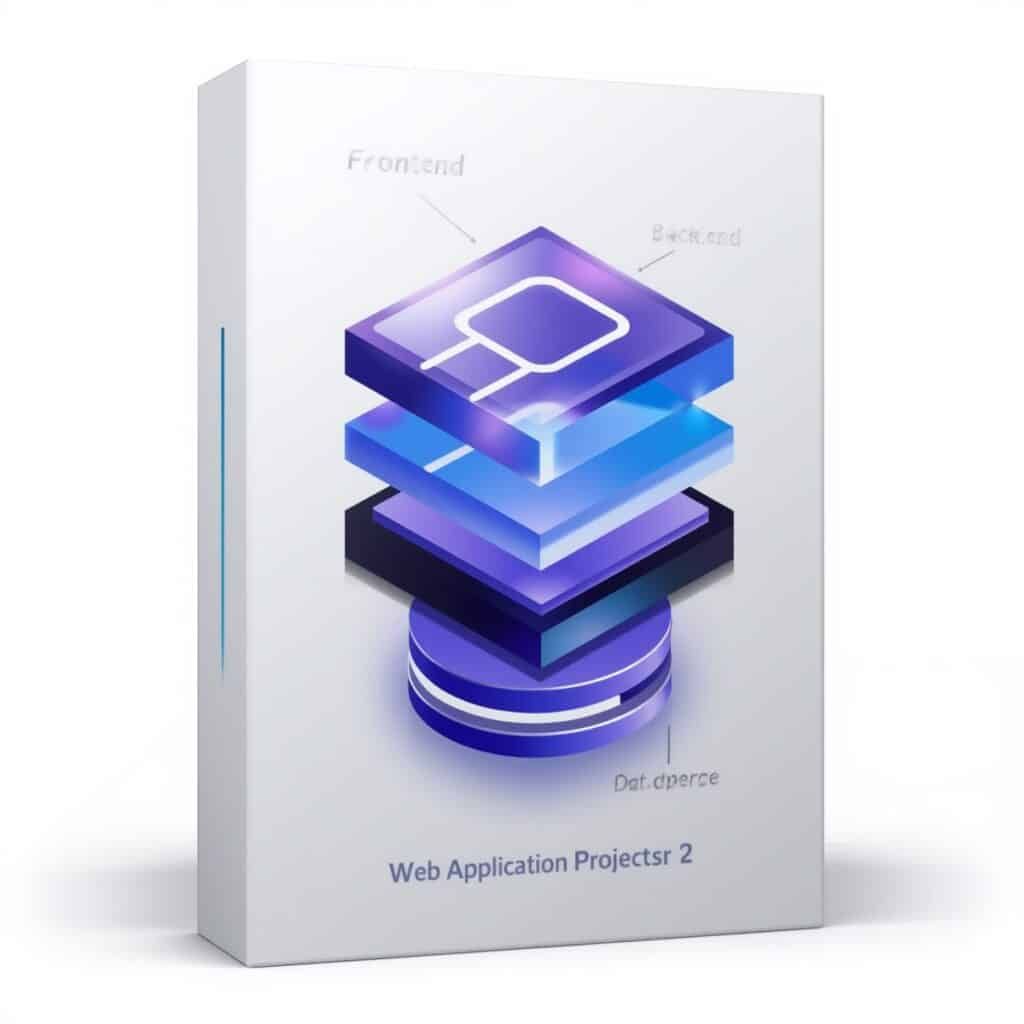
Every substantial Web application project adheres to a fundamental architectural model, typically known as the client-server model. Understanding these structural components is the first step toward building successful Web application projects. These components, often referred to as the ‘stack,’ are traditionally broken down into three layers: the Frontend (client-side), the Backend (server-side), and the Database (data storage). The interplay between these three elements dictates the functionality, speed, and reliability of all Web application projects.
A. Frontend
The frontend is the part of the Web application project that the user sees and interacts with directly in their browser. It is the crucial interface for any Web application project, determining user adoption and satisfaction. It is built primarily using three core languages: HTML (HyperText Markup Language) for structure, CSS (Cascading Style Sheets) for styling and presentation, and JavaScript for interactivity and dynamic behavior.
Modern Web application projects rarely rely on vanilla JavaScript alone. Instead, developers utilize powerful frontend frameworks and libraries such as React, Vue.js, or Angular. These tools allow for the creation of complex, single-page applications (SPAs) that offer a seamless, desktop-like experience within a browser. Building responsive design into all Web application projects—ensuring they function perfectly on mobile devices, tablets, and desktops—is a mandatory requirement in today’s development environment. The success of a Web application project often hinges on how intuitive and fast its frontend
B. Backend
The backend is the engine room of the Web application project. It is responsible for handling the logic, calculations, security, and communication with the database. When a user interacts with the frontend (e.g., clicking a login button), the request is sent to the backend server. The server processes this request, executes the necessary business logic, retrieves or updates data, and sends the appropriate response back to the frontend.
Popular technologies for building the backend of Web application projects include Python (with frameworks like Django and Flask), Java (with Spring Boot), Node.js (with Express.js), and PHP (with Laravel or Symfony). The choice of technology for a Web application project often depends on factors like scalability requirements, existing team expertise, and the complexity of the processing needed. For example, high-performance or enterprise-level Web application projects might favor Java, while rapid development and data science applications might lean toward Python. Regardless of the language, the backend’s job is to ensure the Web application project runs securely and efficiently.
C. Database
The database is where all persistent data for the Web application project is stored. This includes user profiles, content, transactions, settings, and every piece of information the application needs to operate. Without a robust database, a Web application project cannot retain state or information across user sessions.
Databases fall broadly into two categories for Web application projects:
- SQL (Relational) Databases: These use structured schemas and defined relationships (e.g., PostgreSQL, MySQL, SQL Server). They are excellent for Web application projects that require strict data integrity and complex transactions (like financial or e-commerce applications).
- NoSQL (Non-relational) Databases: These are more flexible, storing data in formats like documents (MongoDB), key-value pairs (Redis), or graphs. They are ideal for Web application projects that need rapid scaling, handle large volumes of unstructured data, or require frequent schema changes.
Selecting the right database is a critical architectural decision for any Web application project, directly impacting its long-term performance and maintainability.
III. Categorizing Web application projects for Different Goals
The universe of Web application projects is vast and varied, but they can be functionally categorized based on their purpose, target audience, and complexity. Understanding these categories—especially the differences between readymade web application projects, final year web application projects, and trending web application projects—is essential for making informed decisions about your development path.
A. Readymade Web application projects
The category of readymade web application projects refers to pre-built, packaged solutions or existing source code that is ready for deployment or minor customization. These projects are often developed to solve common business or academic problems and are sold or provided to allow users to quickly acquire a fully functional application. The key characteristic of readymade web application projects is speed and demonstrable functionality.
- When to Use Readymade Web application projects:
- Prototyping: They serve as excellent starting points, providing a foundation that can be quickly customized for a proof-of-concept.
- Learning: Analyzing a complete, functional Web application project is an invaluable educational tool. Beginners can dissect the code structure, database schema, and deployment process without building from scratch.
- Quick Deployment: For businesses needing a standard solution immediately (e.g., a simple HR portal or inventory system), readymade web application projects offer a substantial time-to-market advantage.
While highly efficient, using readymade web application projects comes with caveats. Developers must ensure they have the rights to the code and that the structure is well-documented. Furthermore, relying on readymade web application projects for academic work requires careful consideration; while they provide context, final year web application projects often require a substantial component of original work. Nevertheless, for accelerating the development lifecycle, readymade web application projects are a powerful option in the developer’s toolkit. They allow teams to focus less on boilerplate code and more on unique feature integration. The availability of diverse readymade web application projects highlights the maturity and modular nature of the web development ecosystem.
B. Final Year Web application projects
For students, final year web application projects represent the culmination of years of study. These projects are not just technical exercises; they are an opportunity to demonstrate mastery across the entire spectrum of software development, including research, design, implementation, and rigorous documentation. Final year web application projects demand innovation and relevance, often pushing the boundaries of current technology.
A successful final year web application project must meet high criteria:
- Novelty and Complexity: The project must solve a unique problem or offer a significantly improved solution over existing systems. Simple CRUD (Create, Read, Update, Delete) applications are generally insufficient; the best final year web application projects incorporate advanced algorithms, emerging technologies, or complex logic.
- Implementation Quality: Clean, modular code, efficient database design, robust error handling, and comprehensive security measures are essential components of high-scoring Web application projects.
- Documentation: Detailed reports, including requirements analysis, design specifications
- AI/ML Integration in Web application projects: Building systems that incorporate machine learning models for tasks like predictive analysis (e.g., stock market prediction, crop yield forecasting) or intelligent content filtering. A Web application project that classifies images or predicts trends based on user data demonstrates cutting-edge skills.
- Big Data and Data Mining Web application projects: Developing a Web application project that processes and visualizes large datasets, perhaps offering novel data mining techniques for business intelligence or academic research. These projects require expertise in handling massive throughput and complex analytical queries.
- Security-focused Web application projects: Creating a robust system that explores new authentication methods (e.g., risk-based authentication), secure communication protocols, or tools for vulnerability assessment and penetration testing. The focus here is on securing the integrity of the data within the Web application project.
The key to succeeding with final year web application projects is meticulous planning. Students must choose a domain they are passionate about and ensure the scope is manageable within the project timeline. Leveraging modern frameworks like Django (Python) or Spring (Java) for the backend and React or Vue for the frontend can significantly enhance the complexity and polish of the resulting Web application projects. The rigor associated with final year web application projects serves as invaluable training for a professional development career.
C. Trending Web application projects
Staying current with the latest technological shifts is paramount for developers building modern Web application projects. Several key trends are defining the next generation of online applications, offering exciting opportunities for innovation. Incorporating these into your portfolio ensures your Web application projects remain relevant.
- Progressive Web Apps (PWAs): These are Web application project that leverage modern browser capabilities to deliver an app-like user experience. They are fast, reliable (working offline), and installable on the user’s home screen, bypassing traditional app stores. Building a PWA as a Web application project demonstrates an understanding of service workers, manifest files, and responsive design principles.
- Blockchain and Decentralized Web application projects : While still a niche, dApps represent the cutting edge. They are Web application project where the backend logic runs on a decentralized network (a distributed ledger). Creating a simple decentralized identity service or a voting application demonstrates proficiency in web3 technologies and smart contract development (often using Solidity).
- Serverless Architecture: This paradigm involves building Web application project without managing the underlying servers. Services like Google Cloud Functions or similar platform solutions automatically handle scaling and infrastructure. Developing a Web application project that utilizes functions-as-a-service dramatically reduces operational complexity and showcases an understanding of cost-efficient, auto-scaling deployment models.
- AI-Powered Personalization: Integrating AI into Web application project to personalize user experiences is a major trend. This could involve building recommendation engines, automated customer service chatbots, or dynamic content generation tools. These highly sophisticated Web application projects are quickly becoming the industry standard.
IV. Mastering Simple Web application projects
The path to building complex, enterprise-level Web application projects begins with mastering simple web application project. These foundational exercises are crucial for solidifying core concepts, understanding the full development lifecycle, and gaining confidence with development tools. Every seasoned developer started by successfully completing simple web application project.
A. Simple Web application projects: Why Simplicity is Key
The goal of a simple web application project is not to impress with complexity, but to flawlessly execute fundamental building blocks. Beginners often make the mistake of attempting too much too soon, leading to burnout and unfinished work. By starting with simple web application project, you can focus on one concept at a time:
- Focusing on Fundamentals: A simple web application project allows you to concentrate on basic HTML form handling, the nuances of client-side JavaScript logic, or the pure execution of a CRUD operation without the distraction of complex security configurations.
- Rapid Iteration: You can build, test, and deploy a simple web application project much faster, providing the immediate feedback loop necessary for effective learning.
- Bridging Theory and Practice: The theory learned in textbooks—HTTP requests, event handlers, DOM manipulation—becomes concrete when applied to a simple web application project like a calculator or a basic task tracker.
Successfully completing multiple simple web application project builds a robust understanding that is essential when tackling more ambitious Web application project, such as those involved in final year web application project or commercial ventures.
B. 10 Essential Simple Web application projects Ideas
Here is a list of highly effective simple web application projects designed to reinforce different fundamental skills:
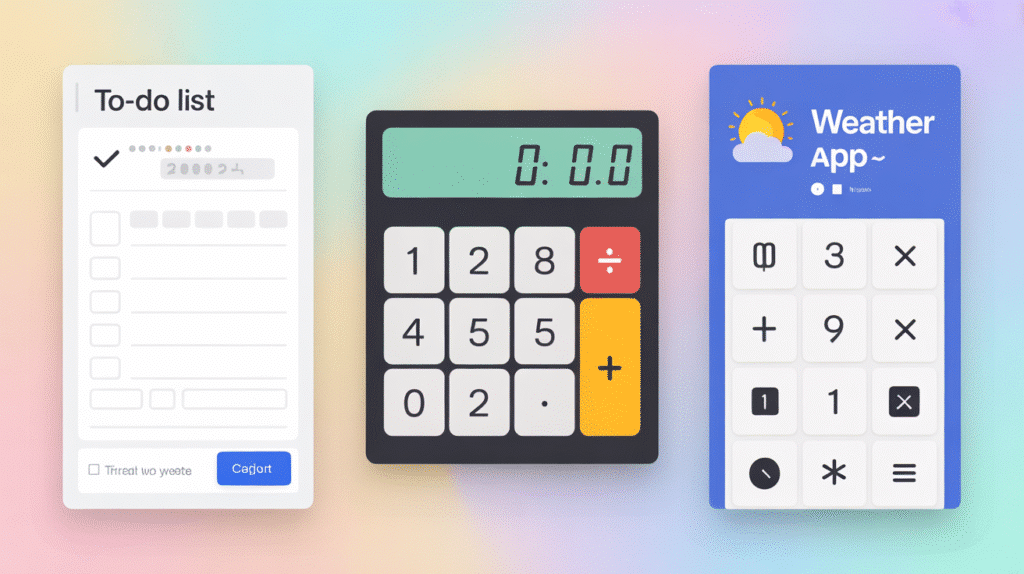
- To-Do List/Task Tracker: This is arguably the most foundational simple web application project. It teaches basic form input, local storage management (to save tasks across sessions), and DOM manipulation (to dynamically add and remove tasks). It’s perfect for understanding basic state management.
- Simple Calculator: Focuses entirely on client-side JavaScript logic. The complexity lies in handling operator precedence and chained calculations. It’s a classic example of a simple web application project demonstrating numerical processing.
- Weather App: This project introduces the concept of External APIs. It is a simple web application project that involves making an asynchronous request (using fetch or Axios) to a public weather API, handling the JSON response, and presenting the data visually to the user.
- Recipe Finder: A step up from the weather app, this simple web application project uses a recipe database API. The core challenge is implementing basic search functionality and filtering results based on user input or dietary preferences.
- Basic Blog/CMS (Content Management System): This is the first step toward a full-stack simple web application project. It requires a database to store posts and comments and involves setting up basic routing (e.g., /posts/1, /about). It is a practical demonstration of how Web application project manage content.
- URL Shortener: A slightly more advanced simple web application project that requires backend work. The server must accept a long URL, generate a unique short code, store the mapping in a database, and perform a 302 redirect when the short code is accessed.
- Quiz Application: Excellent for learning sophisticated state management and event handling. The simple web application project must track the current question, the user’s answer, a timer, and calculate a final score, providing instant feedback.
- Landing Page Generator: This focuses heavily on the frontend. The simple web application project allows users to input text and select colors/fonts, and it generates a basic HTML/CSS landing page snippet they can copy. It emphasizes design and output generation.
- Contact Form Processor: A vital piece of any Web application project. This project focuses on secure server-side handling of form data, including validation, sanitization, and sending the collected data via email (using a service like SendGrid) or storing it in a small database.
- Markdown Previewer: This simple web application project takes plain text input written in Markdown format and instantly renders the output as formatted HTML, teaching fundamental text manipulation and rendering libraries.
By completing these simple web application projects, the developer builds muscle memory for core programming concepts, laying the groundwork for complex Web application projects.
C. Step-by-Step Development of a Simple Web application project (The To-Do List Example)
Let’s detail the process of building the To-Do List, a quintessential example of a simple web application project, to illustrate the development lifecycle.
Phase 1: Planning and Design
Even the most simple web application project benefits from planning.
- Requirements: Users must be able to: a) Add new tasks. b) Mark tasks as complete. c) Delete tasks. d) See existing tasks upon returning (Persistence).
- Stack: We will use HTML/CSS/JavaScript for the frontend and a basic local storage mechanism for data persistence, keeping the server out of this simple web application project for maximum speed and simplicity.
Phase 2: Frontend Implementation
- HTML Structure: Create the necessary elements: an input field (<input type=”text”>), an “Add” button (<button>), and an unordered list (<ul>) to display the tasks. This is the structural backbone of the Web application project.
- CSS Styling: Apply basic styling to make the simple web application project visually appealing and responsive. Ensure the layout is clean, and the input area is prominent.
- JavaScript Interactivity:
- Event Listeners: Attach an event listener to the “Add” button to capture the text input when clicked.
- DOM Manipulation: Create a new list item (<li>) when a task is added. Include elements within the <li> for the task text and a “Delete” button. This is where the Web application project becomes dynamic.
Phase 3: Adding Persistence to the Simple Web application project
The critical step that transforms a basic script into a true Web application project is persistence. We achieve this using the browser’s Local Storage API:
- Saving Data: Whenever a task is added, deleted, or marked complete, update the JavaScript array of tasks and then use localStorage.setItem(‘tasks’, JSON.stringify(taskArray)) to save the data.
- Loading Data: When the simple web application project loads, check for existing data: localStorage.getItem(‘tasks’). If data exists, parse the JSON back into a JavaScript array and iterate through it, dynamically creating the <li> elements to display the tasks.
Phase 4: Refinement and Deployment
- Error Handling: Add input validation (e.g., prevent the addition of empty tasks). This makes the simple web application project more robust.
- Code Optimization: Refactor the JavaScript code into clean, reusable functions (e.g., renderTasks(), addTask(), saveTasks()).
- Deployment: Deploy the finished files (HTML, CSS, JS) to a free static hosting service like Netlify or GitHub Pages. This completes the development cycle for the simple web application project, turning it into a publicly accessible Web application project.
This methodical approach to even a simple web application project instills the discipline required for managing much larger Web application project in the future, providing a solid, verifiable entry for any developer’s portfolio.

V. Development and Deployment Strategies for Professional Web application project
Moving beyond simple web application projects to professional-grade systems requires adopting industry best practices in security, scalability, and deployment automation. These strategies ensure that Web application projects can withstand heavy traffic, remain secure against threats, and evolve efficiently over time.
A. Security Best Practices for all Web application projects
Security is not a feature; it is a fundamental requirement for all Web application project. Neglecting security is the fastest way to doom a project. Developers must be acutely aware of vulnerabilities outlined by organizations like the OWASP (Open Web Application Security Project).
Key security practices for Web application projects include:
- Input Validation and Sanitization: All user input must be treated as malicious. Implementing strict validation prevents injection attacks SQL, command and Cross-Site Scripting .
- Secure Authentication: Never store passwords in plain text. Use strong hashing algorithms and modern authentication flows
- API Security: Implement rate limiting to prevent denial-of-service attacks and ensure all sensitive API endpoints are protected by appropriate authorization checks.
- Use of HTTPS: Encrypting all data transmission between the client and server is mandatory for any modern Web application project.
By embedding these security protocols from the initial stage, developers ensure they are building trustworthy and resilient Web application projects.
B. Scalability and Performance Optimization
A successful Web application project must be able to handle growth—scaling from a few users to millions. Scalability is the measure of a system’s ability to increase its output under an increased load.
- Horizontal Scaling: The primary method for most Web application project, involving adding more servers (web, database, or application) to distribute the load. This is facilitated by technologies like load balancers.
- Database Optimization: As the heart of the Web application project, the database is often the bottleneck. Techniques like indexing, query optimization, and database sharding are crucial.
- Caching: Implementing layers of caching (Content Delivery Networks or in-memory caching like Redis) dramatically improves the performance of Web application project by storing frequently accessed data and reducing the need for repeated database lookups.
- Code Efficiency: Efficient algorithms and optimized code execution minimize the time spent processing requests, ensuring the Web application project remains responsive even under high load.
C. DevOps and CI/CD for modern Web application projects
The modern development of Web application projects relies heavily on automation through DevOps practices and Continuous Integration/Continuous Deployment (CI/CD) pipelines.
- Continuous Integration (CI): This means developers integrate code into a shared repository frequently. Automated builds and tests are run to immediately detect errors. This ensures the codebase for the Web application project is always in a working state.
- Continuous Deployment (CD): Once code passes automated tests, it is automatically deployed to staging or production environments. Tools like Jenkins, GitLab CI, or GitHub Actions automate this entire process.
- Infrastructure as Code (IaC): Using tools like Terraform or Ansible to define the infrastructure (servers, networks, databases) as code. This makes the deployment of the Web application project repeatable, scalable, and version-controlled.
Automating the deployment of Web application projects reduces human error, increases deployment frequency, and allows development teams to focus more on feature creation.
D. Testing: Unit, Integration, and End-to-End Testing for robust Web application projects
Testing is the guarantee of quality for any Web application project. A robust testing strategy ensures reliability, especially as the project scales beyond simple web application project
- Unit Tests: Focus on testing the smallest, isolated units of code (e.g., a single function or method). They are fast to run and pinpoint exact errors in the logic of the Web application project.
- Integration Tests: Verify that different modules or services within the Web application project interact correctly (e.g., ensuring the backend service successfully communicates with the database).
- End-to-End (E2E) Tests: Simulate a real user journey through the entire Web application project (e.g., a user logging in, adding an item to a cart, and checking out). Tools like Cypress or Selenium are essential for E2E testing of Web application projects.
A comprehensive test suite is an investment that saves enormous time and resources in the long run, guaranteeing that any deployed Web application project provides a stable user experience.
VI. Frequently Asked Questions
1. What is the single most important skill for developing successful Web application projects?
The key skill for Web application projects is strong problem-solving and logical thinking. Coding only works when the logic is clear. Good developers can understand a problem, break it into simple steps, plan the solution, and predict issues early. This skill is important for both small web apps and large systems.
2. How long does it take to build a basic simple web application project?
A simple web application project like a calculator, portfolio site, or basic weather app can be completed in a day if the developer knows HTML, CSS, and JavaScript well. If the project has a backend, it may take 3 to 5 days for planning, coding, and testing. The key is keeping the project small and simple.
3. Where can I find support and source code for my final year web application projects?
Students can use GitHub and coding forums for free help with web application projects. But for organized, domain-specific support, especially in advanced areas, services like ClickMyProject are useful because they provide ready-made ideas, source code, and documentation.
4.What specific technologies do ClickMyProject offer for their Web application projects?
ClickMyProject offers Web application projects in many languages and domains to match academic and industry needs. Students can choose projects in Java, Python, PHP, or .NET, and domains like Machine Learning, Data Mining, Cloud Computing, Web Services, and Network Security. They also provide projects with mobile and database technologies, making it easy for students to find a project that fits their specialization.
5.Are the Web application projects provided by ClickMyProject suitable for academic submission?
Yes, ClickMyProject Web application projects are suitable for academic submission. They include full source code and documentation. Students just need to understand the project well and add a small unique change to make it their own before submitting.
VII. Conclusion
The journey through the world of Web application project from mastering simple web application projects like the basic To-Do list to deploying intricate, scaled cloud solutions—is a perpetual process of learning and refinement. We have established that Web application projects are the essential vehicles driving digital interaction today, requiring proficiency in frontend design, backend logic, data management, security, and automated deployment.
Whether you are seeking quick readymade web application projects for concept validation, aiming to submit rigorous final year web application projects in cutting-edge domains, or simply starting your path with a simple web application project, the core principles remain constant: methodical planning, clean execution, and a persistent focus on solving real user problems. The demand for skilled developers capable of building robust, innovative Web application projects will only continue to accelerate, solidifying web application development as one of the most exciting and rewarding career paths in the technological landscape. Embrace the challenge, keep building, and remember that every significant digital experience began as a well-conceived Web application project.